

Rosehip oil for scars: when and how to apply it
A recent scar stays red and changes colour for weeks. Rosehip oil for scars is a well-chosen plant oil for this period: nourished and massaged every day, closed skin regains suppleness and comfort.
In practice, here is when to start, how to apply it and what the clinical trial on post-surgical scars observed.
What does rosehip oil do for scars?
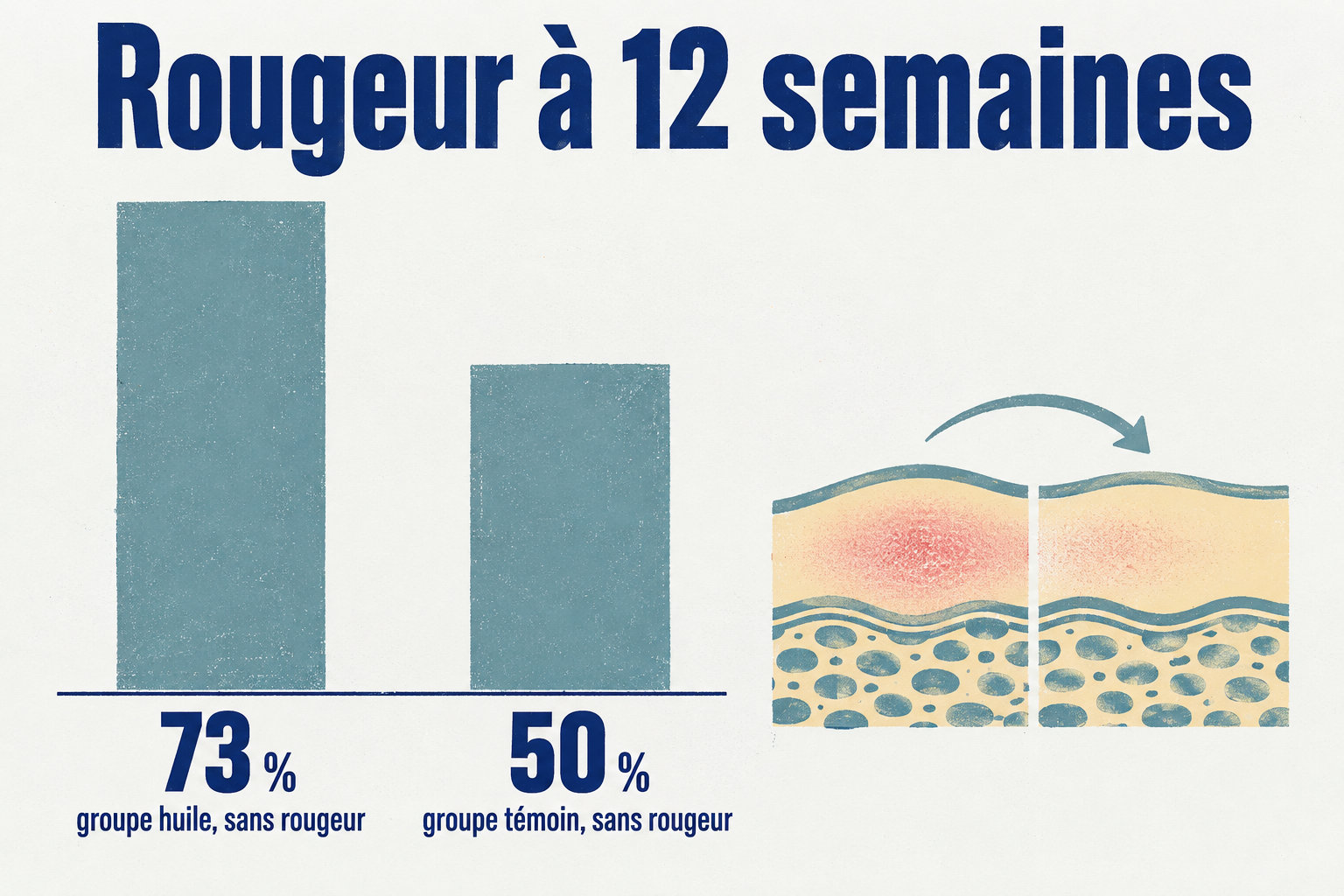
Rosehip oil nourishes and softens the skin of a closed scar, and a clinical trial observed less redness and fewer colour changes on scars massaged with the oil after 12 weeks.
It fits easily into your evening and morning routine, with nothing more than a gentle massage. For its other uses on the face, see the rosehip oil benefits for skin.
- Scars followed for up to 12 weeks in a clinical trial.
- A pure plant oil that is applied without dilution.
- A simple routine, morning and evening, in a few minutes.
What is in the formula
Rosehip oil is a plant oil, pressed from the seeds of the rose's fruit. It is not an essential oil: it is applied undiluted, directly to the skin.
According to a 2017 scientific review, linoleic acid makes up around 36 to 55% of its fatty acids and alpha-linolenic acid 17 to 27%. These essential fatty acids contribute to the skin barrier and to skin suppleness. The oil also contains carotenoids, which give it its orange colour.
- Pure seed plant oil, certified organic by Ecocert.
- Rich in essential fatty acids (omega 6 and omega 3).
- Storage: bottle tightly closed, away from light and heat.
The same quality criteria (cold pressing, organic certification) apply to all our plant oils: see for example how to choose jojoba oil that is organic.
After surgery or a caesarean: when can you start?
After surgery or a caesarean, rosehip oil is applied once the skin has closed completely, with no scab and no raw area, and with your doctor's agreement. In the 2015 trial, application started when the stitches were removed.
Until the wound has closed, leave it alone:
- Do not massage an open wound and do not apply any oil to it.
- Wait until the scab has fallen off on its own and the skin no longer feels tight.
- If the area swells, weeps or becomes painful, show it to your doctor.
Rosehip oil for scars before and after: the 12-week results
The clinical trial published in 2015 followed 108 people to the end: 76 applied undiluted rosehip oil twice a day to a post-surgical scar, and 32 received no care.
From 6 weeks, the oil group showed less redness than the group with no care. At 12 weeks, the gap had widened on several visible measures.
At 12 weeks, here is the share of people without the sign in question in each group.
| Measure at 12 weeks | Oil group | No-care group |
|---|---|---|
| No redness | 73% | 50% |
| No colour change | 63% | 21% |
| No atrophy (sunken or thinned scar) | 85% | 62% |
On these three measures, the "after" picture is therefore more favourable in the group that massaged their scar with the oil. That is why rosehip is so often linked with caring for recent scars.
How do you use rosehip oil for scars?
Rosehip oil is applied undiluted, twice a day, as in the 2015 trial, by gently massaging the closed scar for a few minutes with your fingertips.
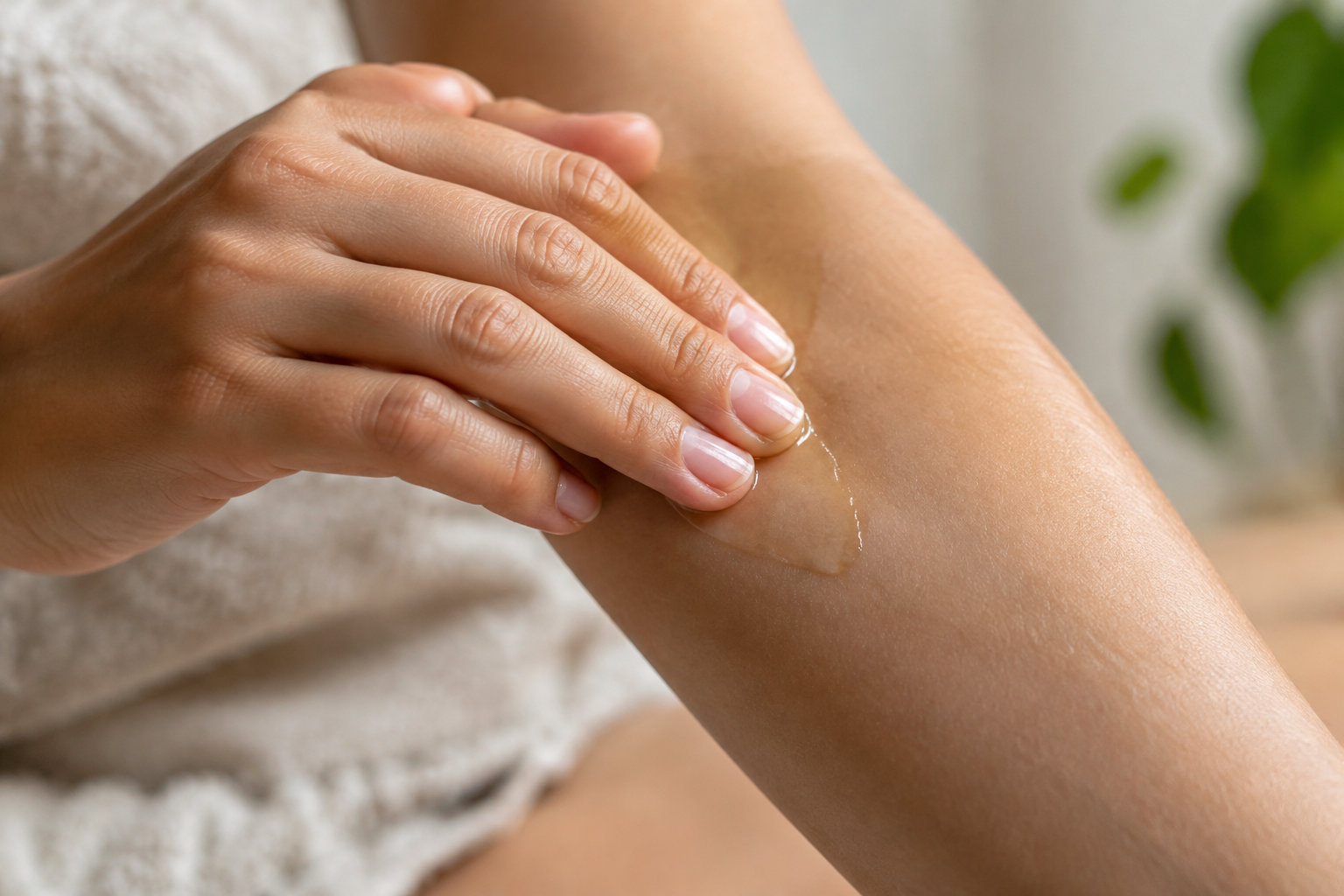
Clean the area and pat it dry.
Put 2 to 3 drops of oil on your fingertips.
Massage the scar in small circles for a few minutes, until absorbed.
Repeat morning and evening, every day, for several weeks.
Before the first application:
- Test a small amount on a discreet area, such as the forearm, for 24 hours.
- If redness or itching appears, stop using it.
- There is no need to dilute rosehip oil: it is a plant oil, not an essential oil.
Which scars can you use it on?
Recent scars after surgery
Recent post-surgical scars are the ones studied in the 2015 trial: this is the best-documented use of rosehip oil on a scar, as soon as the skin has closed.
Older scars and blemish marks
On an older scar or a mark left by a spot, the oil nourishes the skin and softens it during massage. The area feels more comfortable, and its appearance changes from one skin to another.
Thick or itchy scars
A scar that thickens, spreads beyond the edges of the wound or itches deserves a doctor's opinion, who will point you towards suitable care.
On sensitive skin, apply one drop to the forearm and wait 24 hours before the first application on the scar. If there is no reaction, you can use it every day.
How long does a bottle last?
At €9.99, Bon Sens Organic Rosehip Oil lets you massage a scar daily for months: a few drops are enough for each application.

€9.99
Pure plant oil, certified organic by Ecocert. Free delivery from €19, free returns within 30 days.
It belongs to our organic plant oils and also works for the face, the body and dry hair ends: one bottle for several uses.
Your next step: wait until the skin has closed, test the oil on a small area, then massage the scar morning and evening.
Frequently asked questions
What is the best oil for scars?
Rosehip is one of the most studied plant oils for the look of recent scars: a trial published in 2015 observed less redness after 12 weeks in people who applied it twice a day.
Rosehip oil on a scar: how long before you see a before and after?
In the 2015 trial, redness was already lower at 6 weeks in the oil group, and at 12 weeks the gap also covered colour and sunken areas. So allow several weeks of regular application, morning and evening.
Can you use rosehip oil on your face?
Yes, rosehip oil can be used on the face, on clean, closed skin with no scab and no raw area. We suggest 2 to 3 drops, morning and evening, after a test on a small area.
How long does rosehip oil keep once opened?
Rosehip oil keeps for the period shown on the bottle label. Keep the bottle tightly closed, away from light and heat, to keep it fresh. A rancid smell means it is time to replace it.