

Rosehip oil benefits for ageing skin
The main rosehip oil benefits for skin come from its make-up: linoleic acid accounts for roughly 36 to 55% of its fatty acids and alpha-linolenic acid for 17 to 27%, according to a 2017 scientific review. As we age, collagen production slows and skin holds on to water less well, letting wrinkles and pigmentation marks show through.
This guide covers what this plant oil can do for mature skin, how to fit it into your routine and which precautions to take, with realistic expectations.
- What are the rosehip oil benefits for mature skin?
- How does rosehip oil work on skin?
- 4 visible rosehip oil benefits on signs of ageing
- How do you add rosehip oil to your daily routine?
- Rosehip oil or synthetic retinol: what is the difference?
- How do you choose a high-quality rosehip oil?
- Precautions and realistic timescales
What are the rosehip oil benefits for mature skin?
The main rosehip oil benefits for mature skin start with its omega 3 and 6 fatty acids, which help keep skin supple. The same review notes that linoleic acid plays a direct role in maintaining the barrier that limits water loss. Skin that lacks lipids keeps a softer texture as a result.
These essential fatty acids top up the hydrolipidic film. They help mature skin cope better with cold, wind and pollution. Your skin barrier is better looked after day to day.

€9.99
Our Organic Rosehip Oil (€9.99) nourishes dry skin that lacks lipids. It is applied neat, a few drops at a time. You get a feeling of comfort and softer skin. It is part of our organic plant oils, alongside jojoba, black seed and castor oil.
- Essential fatty acids (omega 3 and 6), plus omega 9
- Carotenoids (vitamin A precursors)
- Vitamin E (tocopherols)
A natural source of vitamin A and carotenoids
Carotenoids give the oil its orange colour and are precursors of vitamin A, which is known for its role in skin renewal. Used regularly, the oil helps refine the look of skin texture.
Collagen and elastin keep your face firm and well supported, and their production slows with age. A plant oil does not replace these fibres, but well-nourished skin looks suppler and bouncier.
On the complexion, the main effect is a more natural glow. Nourished skin reflects light better and looks more even.
How vitamin E protects against oxidation
Vitamin E is an antioxidant. It limits the oxidation of lipids, both in the bottle and on the surface of the skin. It helps protect skin from everyday oxidative stress.
Tocopherols (the different forms of vitamin E) settle into the lipid layers of your skin. Your face copes better with changes in weather and with pollution.
Vitamin E and carotenoids are two complementary antioxidants. Together they help keep thin, mature skin comfortable, without replacing sun protection.
How does rosehip oil work on skin?
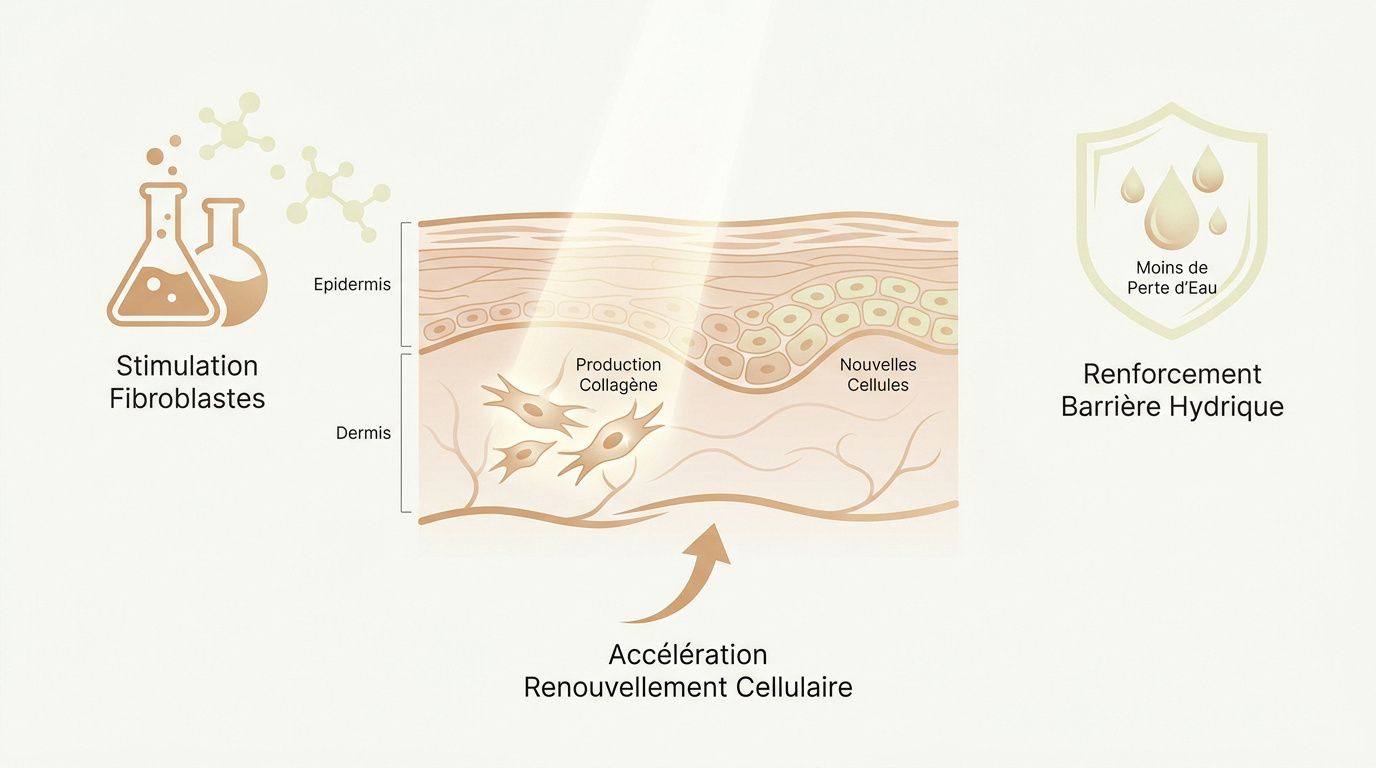
Rosehip oil works mainly on the surface: it nourishes the outer layer of the skin, limits water loss and supports the skin's natural renewal.
Collagen: what to expect from an oil
Collagen is made by fibroblasts, cells found in the dermis. Their activity naturally slows down over the years.
The available evidence does not show that an oil applied to the skin increases the density of the dermis. Well-hydrated, nourished skin does, however, look bouncier.
The oil mainly helps smooth the look of fine lines caused by dryness, while keeping your face comfortable day to day.
Worth knowing before you start: a plant oil nourishes and softens the skin, it does not replace a prescribed treatment or a dermatologist's advice.
A more even skin texture
Dry skin sheds unevenly, which makes it look dull and rough. By nourishing the surface, the oil helps skin feel softer to the touch.
Skin texture looks more even. The surface is smoother and your complexion looks clearer.
For dull skin that easily shows tiredness, it is a gentle option: a more natural radiance, without a harsh exfoliant.
A stronger barrier against water loss
The oil limits water loss through the skin. It helps hold in the moisture from your water-based products. This matters for mature skin, which is often dry.
The oil's lipids top up those of the skin's outer layer. Your skin barrier is better looked after and skin feels suppler.
To round off your facial routine, a good-quality jojoba oil pairs well with rosehip.
4 visible rosehip oil benefits on signs of ageing
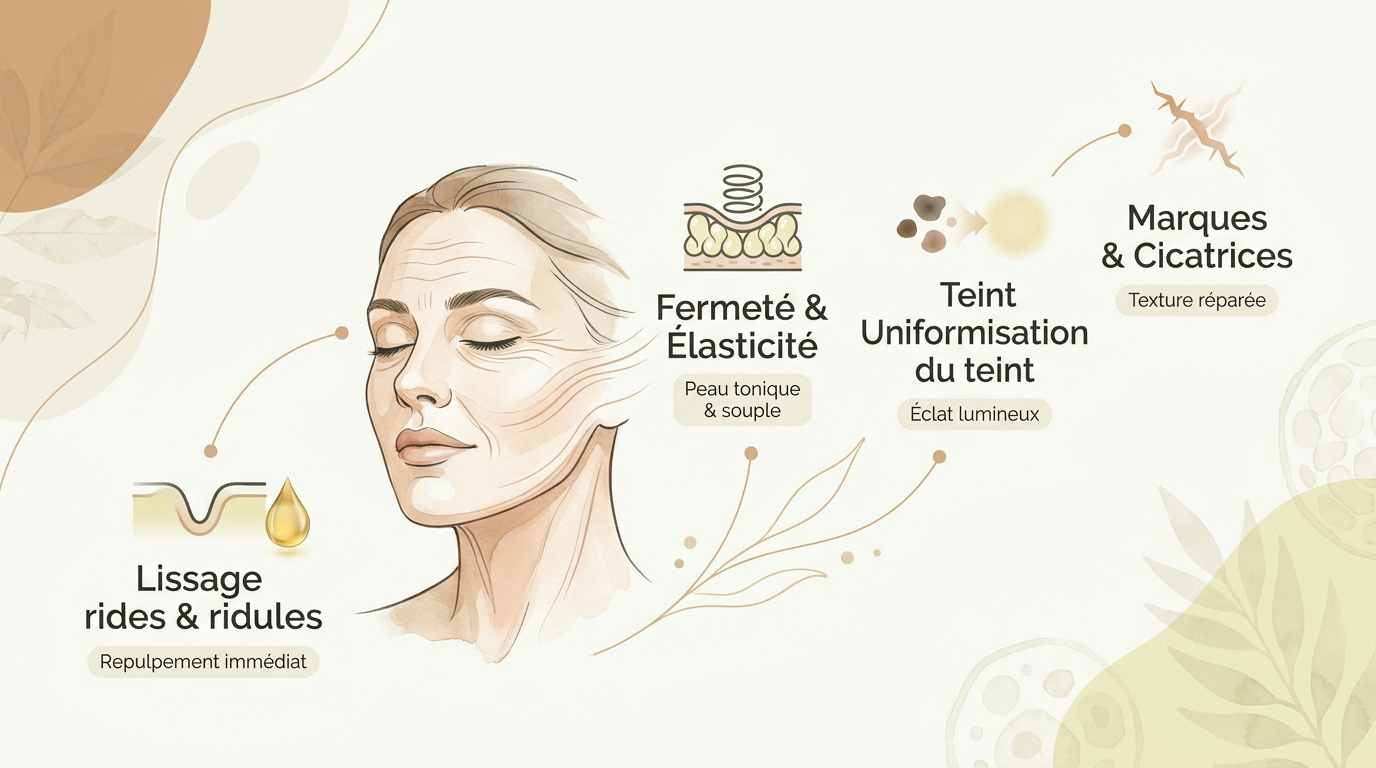
On mature skin, rosehip oil benefits show mainly on four visible signs of ageing, with regular use.
The look of wrinkles and fine lines
By nourishing the skin, the oil softens the look of fine lines caused by dehydration. Your features look less tired from the first applications. It is a surface effect, linked to how comfortable the skin feels.
Deeper wrinkles do not disappear with an oil. On supple, well-nourished skin, forehead lines and lines around the eyes may look slightly less marked. Your skin looks more even and rested.
This plant oil can be used on every lined area to restore suppleness. Here is what you can reasonably expect depending on the area.
| Type of line | What the oil does | Aim |
|---|---|---|
| Fine lines | Nourishes | Smoother-looking |
| Frown lines | Softens | More relaxed features |
| Crow's feet | Gentle massage | More rested-looking eyes |
| Nasolabial folds | Adds suppleness | More comfortable skin |
Suppleness and comfort
Nourished skin feels suppler and more toned to the touch. The oil does not replace lost fibres, but it makes areas prone to sagging, such as the cheeks, feel more comfortable.
Do not forget your neck and décolletage when applying. These thin areas dry out quickly and appreciate a nourishing oil.
Your skin copes better with cold, wind and central heating. That comes from a skin barrier kept in good shape by essential fatty acids.
Skin tone and pigmentation marks
A plant oil does not erase brown spots caused by the sun. Well-nourished skin does, however, look more even and brighter.
To limit new dark spots, the most useful step is daily sun protection. Rosehip oil comes on top of that, not instead of it.
Light reflects better off supple, nourished skin. You get a natural, healthy-looking glow without make-up.
The look of leftover marks
Rosehip oil is traditionally used to care for marked skin. A 2015 clinical study on post-surgical scars observed a cosmetic improvement in their appearance after 12 weeks of use. It nourishes and softens marked areas, but it does not replace medical advice.
On marks left by old blemishes, skin regains a pleasant softness to the touch. Never apply the oil to an open wound.
On an older scar, the oil softens the skin during massage. The mark may look less visible, but results vary from person to person.
How do you add rosehip oil to your daily routine?
Rosehip oil fits into a daily routine as the last step of the evening, following a clear routine that respects your skin's natural rhythm.
The best time for optimal absorption
Evening is the best time. Skin is no longer exposed to sun or pollution, and the oil has all night to absorb at its own pace.
Apply it after your water-based products. Hydrating serums should always go on first. The oil then seals in everything you applied before it.
A few drops are enough on slightly damp skin. The oil absorbs more easily. That way you avoid any unpleasant greasy residue on your pillow.
Apply your water-based serums first.
Follow with your usual moisturiser.
Warm 2 to 3 drops of oil between your palms.
Press onto damp skin to seal in moisture.
How to massage the eye area
Use your ring finger to tap gently. It is the finger that applies the least pressure. Work from the inner corner of the eye outwards.
This gentle movement relaxes the area and nourishes fine lines around crow's feet. Always be very gentle with this delicate area.
Avoid getting too close to the lash line. This limits the risk of irritation. If the oil gets into your eyes, rinse with clean water.
Pairing it with your usual serums and creams
Mix two drops into your night cream. This makes it more nourishing. It is a handy trick for harsh winters.
The oil is compatible with most actives. It pairs very well with hyaluronic acid.
Here are the simplest combinations to get the most out of rosehip oil:
- Mixed into your day cream for radiance
- Paired with hyaluronic acid to plump
- Applied after a vitamin C serum
- Used on its own as an evening treatment
Rosehip oil or synthetic retinol: what is the difference?
Rosehip oil is not a retinol: it is a nourishing oil, gentler but with more modest effects than a synthetic retinoid.
Skin tolerance: what changes
Synthetic retinol can cause redness, tightness and peeling at first. Rosehip oil is generally well tolerated, which makes it a gentler option.
Sensitive skin appreciates it for that reason. It nourishes the skin without an adjustment phase. A patch test is still essential, as any oil can cause a reaction.
Rosehip oil benefits rest on this gentleness: it respects your skin.
Rosehip oil may suit anyone who cannot tolerate conventional retinoids, as long as they accept more gradual effects.
On reactive skin
Effects arrive more gradually. It is an approach that works with your skin, relying on nourishment rather than a strong active.
On reactive skin, the feeling of comfort often comes quickly. The oil nourishes the skin while caring for the signs of ageing.
Do not, however, expect it to match a retinoid on deep wrinkles. Choose it for its gentleness, not to replace a prescribed treatment.
Morning use and sun protection
Synthetic retinol is usually kept for the evening. Rosehip oil can also be used in the morning, as a thin layer under your day cream.
That makes for a simpler routine. Bear in mind, though, that it does not protect from the sun: it is not a sunscreen.
In the morning, always apply sun protection on top, especially in summer. It is the most useful step against dark spots and sun-related skin ageing.
How do you choose a high-quality rosehip oil?
A high-quality rosehip oil is cold pressed, orange to deep amber in colour and slightly earthy in scent. Not all oils are equal, and a few technical details tell you whether the actives are there.
The first non-negotiable point is the extraction method, which must be cold pressing. This mechanical process preserves the essential fatty acids (omega 3 and 6), which are fragile. Solvent extraction followed by refining can degrade these compounds.
Next, go by the colour, which should range from orange to deep amber. This shade shows a high concentration of carotenoids and vitamin A (beta-carotene). A very pale oil has often been refined and then contains fewer carotenoids.
A good-quality oil should have a characteristic scent. It should be slightly herbaceous and earthy. If it smells of nothing, it has probably been over-refined. A fresh, seedy scent is the sign of a living oil rich in lipids.
Rosehip oil vs rose oil: what is the difference?
Do not confuse the vegetable oil with the essential oil. Rosehip oil is extracted from the seeds of the fruit. Rose oil comes from distilled petals.
They have completely different uses in skincare. The vegetable oil can be applied neat to the whole face. The essential oil is a very potent aromatic concentrate that should never be applied neat to the face.
If you are looking for an essential oil for blemish-prone skin, read our article on tea tree oil. Like any essential oil, it is used diluted, after a patch test, and needs precautions (pregnancy, breastfeeding, young children). Rosehip oil, on the other hand, is a nourishing plant oil.
Keeping fragile antioxidants at their best
This oil is particularly prone to oxidation. It contains polyunsaturated fatty acids that react quickly to light and heat. We recommend keeping it in an amber glass bottle.
Always close the cap tightly after each use. Air is the enemy of fresh oil. A rancid oil loses its qualities and can irritate the skin. To keep it at its best, store it in the fridge once opened.
Follow the period-after-opening shown on the bottle to keep it fresh. A rancid smell means it is time to replace it. In short, look after your bottle to look after your skin.
Precautions and realistic timescales
With rosehip oil, patience and caution are your best allies: patch test first, realistic expectations second.
Always do a patch test in the crook of your elbow 24 hours before applying it to your face, to check for any reaction. If your skin is very reactive or you have a skin condition, ask a doctor or pharmacist for advice.
How to patch test sensitive skin
Always test in the crook of your elbow first. Apply one drop and wait twenty-four hours. It is the basic step to limit the risk of an allergic reaction.
Watch for any redness or itching. If nothing happens, you can use it on your face. This simple precaution saves a lot of trouble.
Mature skin is sometimes more reactive than you might think. Any change of routine calls for a gentle approach. Pay attention to the signals your skin sends you.
Realistic timescales for better texture
Comfort and radiance show from the first few applications. Skin looks brighter and less dull. For firmness, though, you need a lot more patience.
To judge texture, allow several weeks of regular use. Changes stay gradual and vary from one skin to another. Consistency matters more than quantity.
Do not be discouraged if wrinkles do not vanish straight away. A plant oil nourishes and softens, it does not erase wrinkles. Lasting effects build up slowly.
Combination skin: what to know
Rosehip oil is often described as low on the comedogenic scale. It generally suits mature combination skin, as long as you use only a little. If blemishes appear, apply it less often.
Its light texture absorbs fairly quickly, which limits any greasy finish on the T-zone.
On combination skin, the routine starts with gentle cleansing. Our comparison helps you choose your soap before applying the oil.
Rosehip oil is a simple ally for mature skin thanks to its essential fatty acids, carotenoids and vitamin E. It nourishes the skin, softens the look of fine lines and brightens the complexion, without replacing sun protection.
In practice, after a patch test, apply 2 to 3 drops every evening to clean, slightly damp skin, or mix them into your usual cream, to keep your face comfortable and radiant.
FAQ
What does rosehip oil actually do for wrinkles on mature skin?
Rosehip oil mainly softens the look of fine lines caused by dryness, thanks to essential fatty acids that nourish the skin and help it hold on to water. On deep wrinkles its effect is modest: it makes skin suppler but does not erase them.
With regular use, skin feels suppler and more comfortable, and your features look less tired.
Does rosehip oil fade age spots?
Rosehip oil does not erase age spots. Rich in carotenoids and vitamin E, it nourishes the skin and gives it a brighter, more even-looking complexion, which makes spots slightly less noticeable.
To limit new spots, the key step is daily sun protection. The oil comes on top of that.
What time of day is best to apply rosehip oil?
We recommend applying it at night to let the oil absorb overnight, away from sun and pollution. Apply the oil after your water-based serums to seal hydration and actives into your skin.
You can also add it to your morning routine, as a thin layer or mixed into your day cream. Then apply sun protection: the oil does not protect from the sun.
Is rosehip oil suitable for combination or sensitive skin?
Generally, yes. Rosehip oil is often described as low on the comedogenic scale and its light texture absorbs fairly quickly. On combination skin, 2 to 3 drops are enough to avoid a greasy finish. Apply it less often if blemishes appear.
For sensitive skin, it is a gentler alternative to conventional retinol and is generally well tolerated. A reaction is still possible with any oil: do a patch test 24 hours beforehand and stop if you notice redness or itching.
How long does it take to see results on skin firmness?
While radiance and comfort can be felt from the first applications, structural changes take more patience. Allow several weeks of regular use to judge the first effects on skin texture.
For suppler, more comfortable skin, we recommend regular use over several months. Effects stay gradual and vary from one skin to another: an oil nourishes, it does not erase wrinkles.