

How to use ravintsara essential oil every day
Knowing how to use ravintsara essential oil every day starts with what is in the bottle. Ravintsara, or Cinnamomum camphora ct cineole, is distilled from the leaves, and its product page lists 50 to 62% eucalyptol, its main component.
Mixing it up with Ravensara, or using a dilution that is too strong, can irritate your skin. Here is how to build ravintsara essential oil into your routine with the right amounts and the right precautions.
- Why choose organic ravintsara essential oil?
- What is in ravintsara essential oil?
- How to use ravintsara essential oil at home
- How to use ravintsara essential oil in a winter routine
- How do you use and store ravintsara oil safely?
Why choose organic ravintsara essential oil?
Organic ravintsara essential oil (Cinnamomum camphora ct cineole) is worth choosing first for its known composition: a chemotyped bottle states its dominant molecule, here eucalyptol. That is what sets it apart from Ravensara, a different Malagasy species with a very different profile.
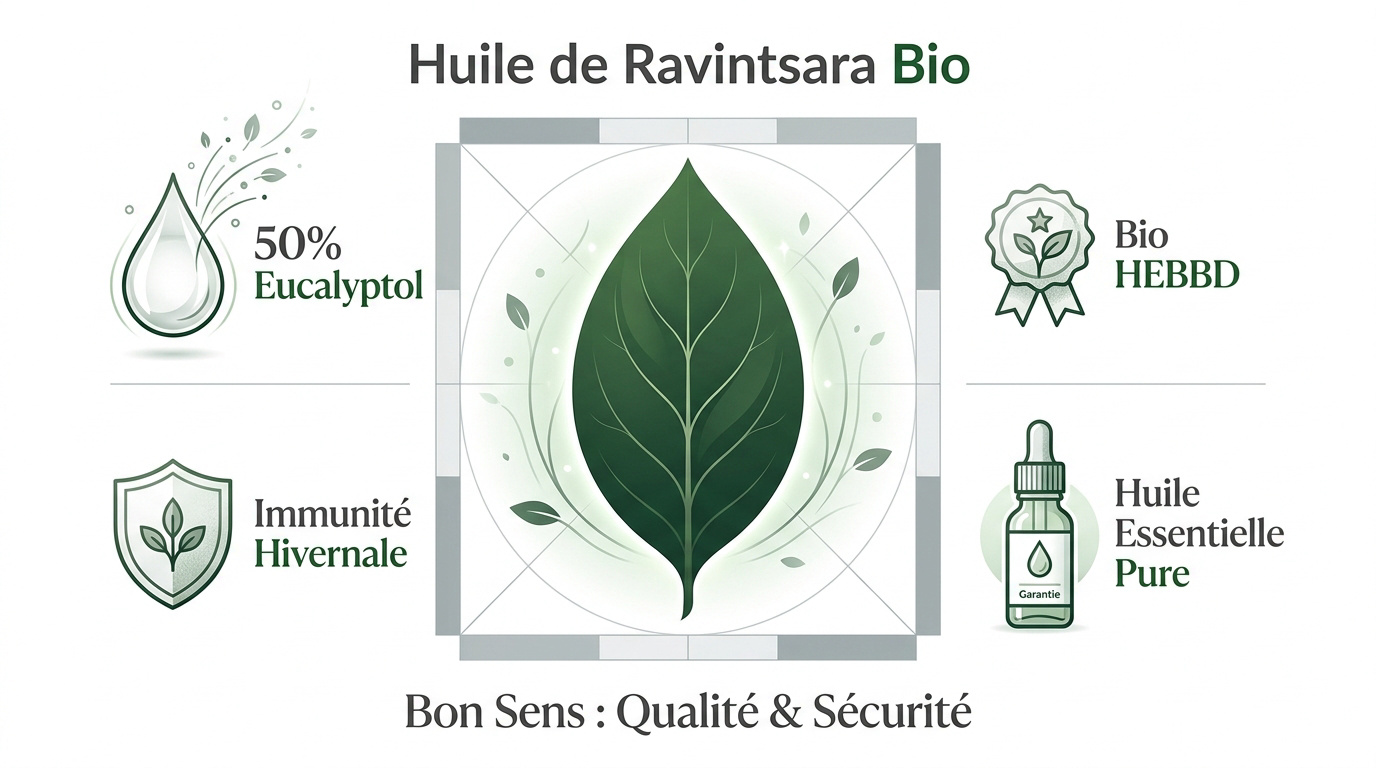
Why pick Bon Sens organic ravintsara?
Our oil is certified organic by Ecocert. It is also HEBBD (botanically and biochemically defined essential oil): the species, the part distilled and the origin are identified, and the biochemical profile is checked in a laboratory.
The leaves come from Madagascar and are steam distilled. The oil is then bottled in France, in a 50 ml glass bottle with a dropper.

Ravintsara is one of our organic essential oils, all chemotyped and bottled in France. So you know exactly what is in every bottle.
Ravintsara vs Ravensara: how to tell them apart
Ravintsara (Cinnamomum camphora) and Ravensara (Ravensara aromatica) are two different trees. Never mistake one species for the other: their oils do not have the same composition.
Ravensara oil has a variable composition from tree to tree and batch to batch (sabinene, limonene or methyl eugenol depending on the chemotype), whereas ravintsara is dominated by eucalyptol. Advice for one oil therefore does not apply to the other.
The Latin name and the chemotype on the label are the two things to check before using a ravintsara oil.
Read the label before you buy. Check the Latin name and the chemotype on the bottle. It is a simple safety habit.
What is in ravintsara essential oil?
Ravintsara essential oil is made up mainly of 1,8-cineole, also called eucalyptol, and sabinene. Eucalyptol gives it its fresh scent, close to that of eucalyptus.
Eucalyptol content (1,8-cineole).
Sabinene content.
These ranges are the ones listed on the page for our ravintsara oil. They vary slightly from batch to batch, as with any natural essential oil.
In aromatherapy, ravintsara is mostly valued for the feeling of clearer breathing that its fresh scent brings, especially in winter. This is a traditional use and a sensation, not a proven therapeutic effect.
What can, and cannot, be said about ravintsara
You will often read that ravintsara "strengthens immunity" or "fights viruses". We do not repeat those promises: an essential oil sold as a wellbeing product is no substitute for a diagnosis or a treatment.
What can honestly be said: its scent is fresh and invigorating, it diffuses well in winter and it blends easily with other camphoraceous oils. If you have a fever, a lingering cough or any breathing difficulty, see your GP.
How to use ravintsara essential oil at home
There are three ways to use ravintsara essential oil at home: in a diffuser, as a dry inhalation and in massage, always diluted in a carrier oil.
How do you diffuse or inhale ravintsara?
For your diffuser, follow the device's instructions: a few drops are usually enough, depending on the size of the room. Diffuse in short sessions of 30 minutes at most, then take a break at least as long. Air the room, and do not diffuse around young children, pregnant women or people with asthma.
Dry inhalation is a simple alternative. Put two drops on a clean tissue and breathe in calmly for a feeling of freshness. It is a handy option when you are out and about.
- Fresh scent around the home
- A moment's pause during the day
- A calm atmosphere in the evening
Many people enjoy this scent as a way to take a break. It pairs well with citrus oils for a softer atmosphere.
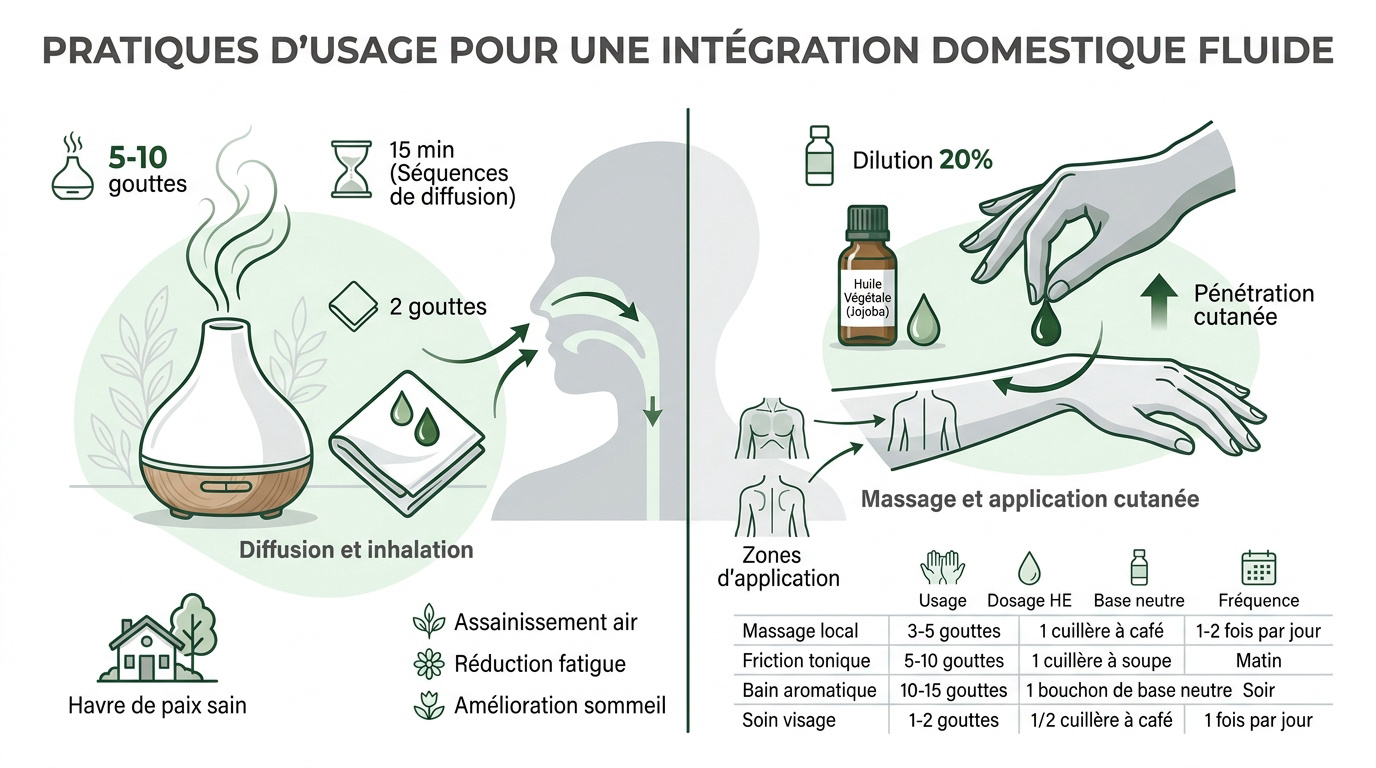
How much should you dilute ravintsara for massage?
On the skin, ravintsara is always diluted in a carrier oil. Established aromatherapy guidance puts body massage between 1 and 3% essential oil, and facial care between 0.5 and 1%. Start with the lowest amount.
Choose a good-quality neutral base, such as jojoba oil. For the detailed maths, our guide to diluting essential oils gives the drop equivalents.
Massage gently into the upper back or chest, avoiding the face, eyes and mucous membranes. A stronger blend does not mean more benefit, only more risk of irritation.
| Use | Essential oil | Carrier oil | Dilution |
|---|---|---|---|
| Local massage (chest, back) | 4 to 6 drops | 10 ml | about 2 to 3% |
| Body massage | 3 to 4 drops | 10 ml | about 1.5 to 2% |
| Facial care (not around the eyes) | 1 to 2 drops | 10 ml | about 0.5 to 1% |
Drop equivalents are approximate, because drop size varies from one dropper to another. They match the guideline on our product page: 2 to 3 drops per teaspoon of carrier oil.
How to use ravintsara essential oil in a winter routine
A winter routine with ravintsara essential oil stays simple: one short diffusion session during the day, a dry inhalation when you want it and a diluted massage in the evening if you enjoy it.
A simple routine through the day
In the morning, run one short diffusion session in your main room, then air it. There is no need to put neat oil on your wrists: an essential oil is never applied neat to the skin.
In the evening, if you like the ritual, massage your 2% blend into your upper back or chest. It is a moment to relax, not protection against viruses.
With an essential oil, consistency and moderation matter more than quantity.
On your commute, keep a tissue with two drops rather than breathing from the open bottle. You enjoy the scent without overdoing it.
Which oils pair well with ravintsara?
Ravintsara pairs well with Eucalyptus radiata, which has a similar scent. To find out more about that oil, read our article on eucalyptus oil.
Peppermint adds an even fresher note. Use it sparingly: it is stronger and not recommended for children. In a blend, the total amount of essential oil stays within the same dilution, between 1 and 3%.
- 50 ml shea butter
- 20 drops of ravintsara
- 10 drops of eucalyptus
These 30 drops in 50 ml give a dilution of about 3%, the upper limit for use on the body. Apply a small amount in the evening to your upper back or the soles of your feet for a comforting moment before bed. This balm is not suitable for children or for pregnant or breastfeeding women.
How do you use and store ravintsara oil safely?
To use and store ravintsara oil safely: dilute it, do a patch test, never swallow it without medical advice and keep it somewhere cool and dark.
Before any use on the skin, do a patch test: one drop of your diluted blend in the crook of your elbow. Wait until the next day before wider use, and stop if you notice redness or itching. Taking care limits allergic reactions.
Do not swallow ravintsara essential oil on your own initiative. Oral use is only on the advice of a healthcare professional, such as a doctor or pharmacist trained in aromatherapy, in line with safety guidance that reserves ingestion for the advice of a qualified practitioner.
1,8-cineole is one of the terpene derivatives that French regulators contraindicated in suppositories for children under 30 months or with a history of seizures, because of a neurological risk. To be safe, keep the oil out of children's reach and seek medical advice if you have asthma or epilepsy.
How should you store ravintsara to keep its quality?
Keep the oil in its amber glass bottle. Light breaks down aromatic molecules. Store your bottles somewhere cool to limit oxidation.
Heat and air speed up oxidation. Close the cap firmly after each use and go by the best-before date printed on the bottle. An oil whose smell has changed should no longer be used on the skin.
Store bottles upright to protect the dropper. Avoid damp places such as the bathroom. A dark, dry cupboard is the ideal spot.
Organic ravintsara essential oil is a fresh, camphoraceous oil, rich in 1,8-cineole and traditionally used in winter. Diffuse it in short sessions, dilute it to between 1 and 3% for massage and keep it out of children's reach: that is how it earns its place in your everyday routine.
FAQ
How do you use ravintsara essential oil every day?
The easiest way is diffusion: 2 to 3 drops in the water tank of an ultrasonic diffuser, in sessions of 30 minutes at most. Diffusion scents the air and brings a feeling of freshness to the room.
On the go, put 2 drops on a tissue and breathe in calmly. For use on the skin, always dilute the oil to between 1 and 3% in jojoba or another carrier oil before massaging it into your chest or back.
What is in ravintsara essential oil?
Bon Sens ravintsara essential oil contains 50 to 62% eucalyptol (1,8-cineole) and 7 to 17% sabinene, according to its product page. Eucalyptol gives it the fresh, camphoraceous scent people look for in winter.
In aromatherapy, ravintsara is traditionally associated with respiratory comfort. This is a traditional use and a sensation: the oil is no substitute for medical advice if you have a cough or a fever.
How can you tell ravintsara from Ravensara?
Check the botanical name on the bottle: ravintsara comes from Cinnamomum camphora ct cineole. Ravensara (Ravensara aromatica) is a different species whose oil is not dominated by eucalyptol.
Ravensara's composition varies widely from tree to tree, which means its safety precautions are different. For your safety, rely on the Latin name and the chemotype on the label of your Bon Sens products.
What precautions apply to ravintsara essential oil?
Ravintsara essential oil is not recommended during pregnancy or breastfeeding, or for children under 6. People with asthma or epilepsy should seek medical advice before use, because cineole is one of the terpene derivatives linked to a risk of seizures in children.
Never apply the neat oil to your skin, and do a patch test in the crook of your elbow before first use. Do not swallow this oil on your own initiative: oral use is only on the advice of a healthcare professional.
How should you store ravintsara essential oil?
Store the oil in a tightly closed amber glass bottle, away from direct light and heat. A stable temperature and a firmly closed cap limit the oxidation of terpenes, which changes the scent and can make the oil more irritating.
Go by the best-before date printed on the bottle. After that date, or if the smell has changed, stop using the oil on your skin.