
Tea tree oil benefits: what the essential oil does and how to use it
Tea tree oil benefits are easy to overstate, and that is where most of the disappointment comes from. Australian standards are often quoted as asking for at least 30% terpinen-4-ol in tea tree oil, yet plenty of people buy on price alone, then apply a poor-quality oil or the wrong dilution and end up with irritated skin and no visible difference. A natural product is not automatically a gentle one, and a few drops used properly will always do more than a generous splash used carelessly.
This guide looks at the composition of Melaleuca alternifolia, the tree the oil is distilled from, so you can judge the real tea tree oil benefits for yourself. You will see how the oil is used on blemish-prone skin, on the scalp and around the home, with clear quantities and the precautions that go with them.
- What are the main tea tree oil benefits, and where do they come from?
- How is tea tree oil used on spots and blemishes?
- Can tea tree oil help with a flaky, oily scalp?
- Can tea tree oil improve your daily oral hygiene?
- Which carrier oil blends extend tea tree oil benefits?
- Safety and storage rules that keep tea tree oil in good condition
What are the main tea tree oil benefits, and where do they come from?
The main tea tree oil benefits come from terpinen-4-ol, a molecule that should make up more than 30% of the oil and that gives it its broad purifying action against bacteria and yeasts in laboratory tests. A good-quality tea tree oil also keeps its 1,8-cineole content low, which makes it more comfortable on the skin once it has been diluted.
In other words, the chemical composition of the oil decides both what it can do and how well your skin is likely to tolerate it.
The role of terpinen-4-ol
Terpinen-4-ol dominates the profile of tea tree essential oil. It is the molecule most often linked to the oil's purifying properties. A content above 30% is the figure generally used as the benchmark for quality. If a supplier publishes the analysis of its oil, this is the first line worth reading.
Terpinen-4-ol: the main purifying molecule in tea tree oil (target: more than 30%).
1,8-cineole: a compound that can irritate the skin when its level goes above 15%.
The 1,8-cineole figure matters just as much as the terpinen-4-ol figure. High levels make skin reactions more likely. Good oils keep it below 15%, so the diluted oil feels gentler when you apply it.
A high terpinen-4-ol content combined with a low cineole content is what defines a good Melaleuca alternifolia oil, and it is what makes the oil suitable for diluted use on the skin.
How tea tree oil acts on microbes
In laboratory conditions, tea tree oil acts on the cell membranes of micro-organisms. Its terpenes are lipophilic, which means they mix easily with the fatty layer of a bacterial wall. The membrane then becomes leaky and loses part of its contents. In those tests, the micro-organism can no longer multiply.
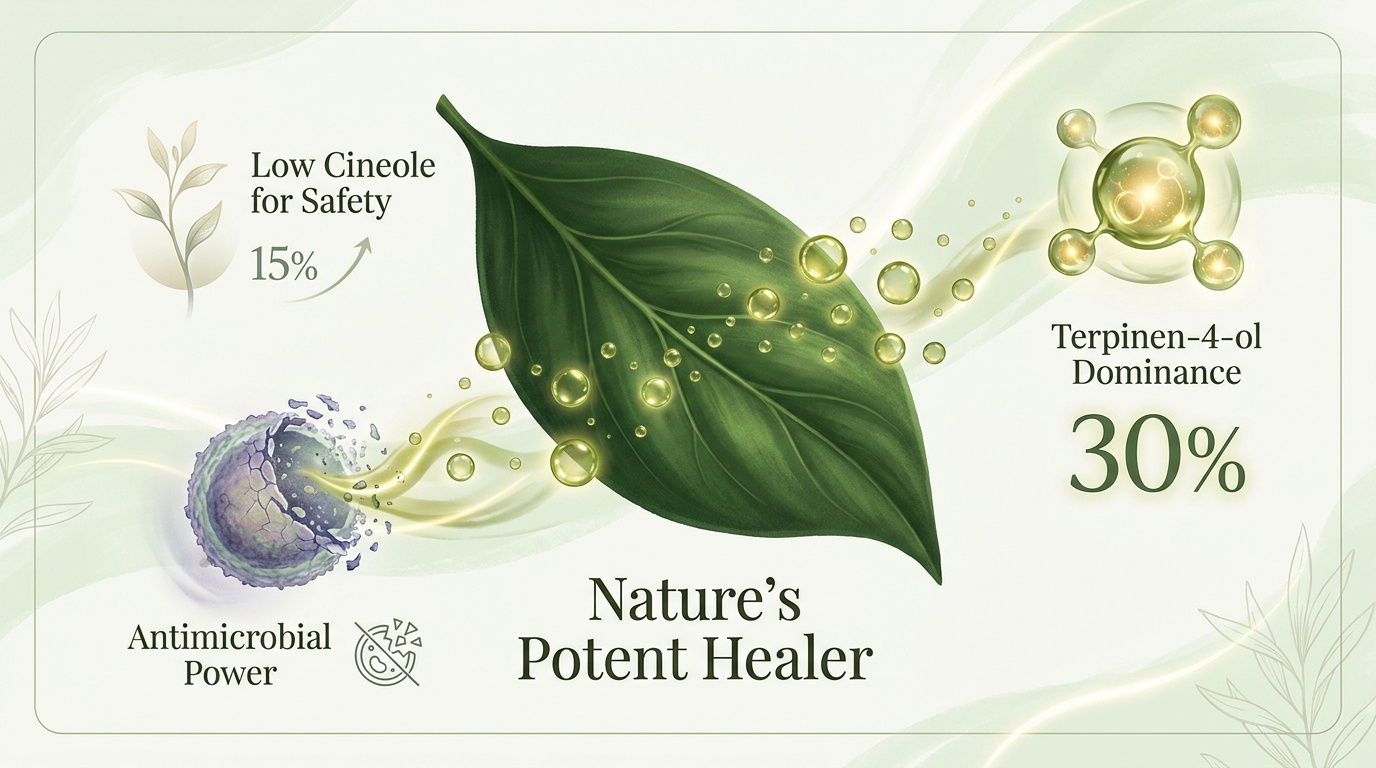
This is why the oil is described as having broad-spectrum activity. It has been tested against a wide range of bacteria. That versatility explains how many everyday uses it has picked up. Some laboratory work also reports activity against certain viruses, which is not the same thing as an effect in the body.

The same laboratory tests show activity against yeasts and moulds. That is why the oil turns up so often in routines for skin that is prone to recurring imperfections. Whatever you use it for, start with a good-quality organic tea tree oil, because a weak or oxidised oil is where most bad experiences begin.
How is tea tree oil used on spots and blemishes?
Tea tree oil is used on spots and blemishes as a targeted, purifying touch, and this is the best-known use of the oil: a tiny amount, applied precisely, as part of a routine for oily or blemish-prone skin.
Dabbing a single blemish
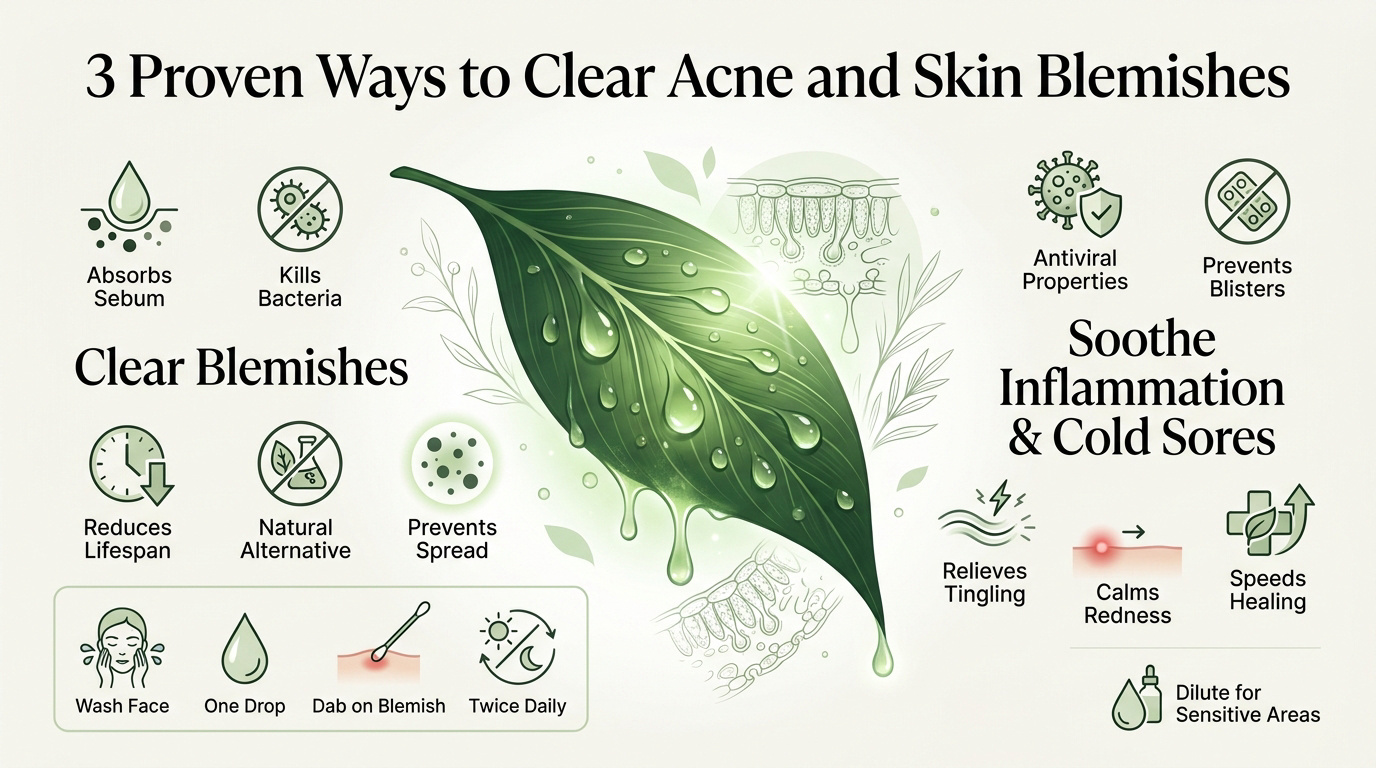
Applied to a single spot, tea tree oil has a drying effect. It helps to absorb excess sebum and has a purifying action on the bacteria associated with blemishes. Many people find that a spot looks less noticeable sooner when they do this. It is often chosen by people who find ingredients such as benzoyl peroxide too harsh, although it is a cosmetic step and does not replace a product prescribed for acne.
- Wash your face thoroughly.
- Put one drop on a cotton bud.
- Dab it directly onto the blemish, not the skin around it.
- Repeat twice a day.
Used like this, the oil keeps its purifying action exactly where you want it. Working with a clean cotton bud also avoids spreading sebum and bacteria to the neighbouring pores. Over time, this helps the skin look clearer. It also makes you less likely to pick at a spot, which is the surest way to leave a mark.
Redness, tingling and cold sores
Tea tree oil is often mentioned for cold sores, because of the antiviral activity reported in laboratory tests. A cold sore is caused by the herpes simplex virus, though, and an essential oil is not a substitute for the advice of a pharmacist. Some people dab on a diluted drop at the very first tingle. What they describe is mostly a fresh sensation that takes the edge off the early tingling or itching.
Tea tree oil is also traditionally credited with soothing properties. The area tends to look less irritated and less raised after a diluted application. For most people, the benefit is simply skin that feels more comfortable while it recovers at its own pace.
Dilution is essential on sensitive areas. Always use a carrier oil (a plain vegetable oil) whenever the area is larger than a single spot, and see a pharmacist or GP for anything that is painful, spreading or slow to clear.
Can tea tree oil help with a flaky, oily scalp?
Tea tree oil can help a flaky, oily scalp feel cleaner and more comfortable, because skincare does not stop at the hairline: the scalp benefits from the same purifying care as the face.
An oily scalp and excess sebum
On an oily scalp, tea tree oil is used for its purifying, sebum-balancing reputation. The aim is hair that does not look greasy again a few hours after washing. A drop or two in your shampoo leaves the scalp feeling fresh and thoroughly clean without drying it out.

Add a few drops to your usual amount of shampoo, in the palm of your hand. Massage it well into the roots to get the most out of it. Rinse thoroughly with lukewarm water and keep the lather away from your eyes.
Used regularly, this helps to limit the build-up of dead skin cells on the scalp. A cleaner scalp is a better environment for the hair that grows from it. Hair that is free of residue also has more natural shine.
Dandruff and the Malassezia yeast
Malassezia is the micro-organism most often associated with dandruff. This yeast lives on the scalp and feeds on its natural oils. Tea tree oil has shown antifungal activity against it in laboratory tests, which is why it appears in so many anti-dandruff shampoos. The idea is to act on one cause of flaking and not only on the flakes you can see.
Studies on shampoos containing 5% tea tree oil have looked at how they affect the presence of Malassezia, the yeast linked to persistent dandruff and an itchy scalp.
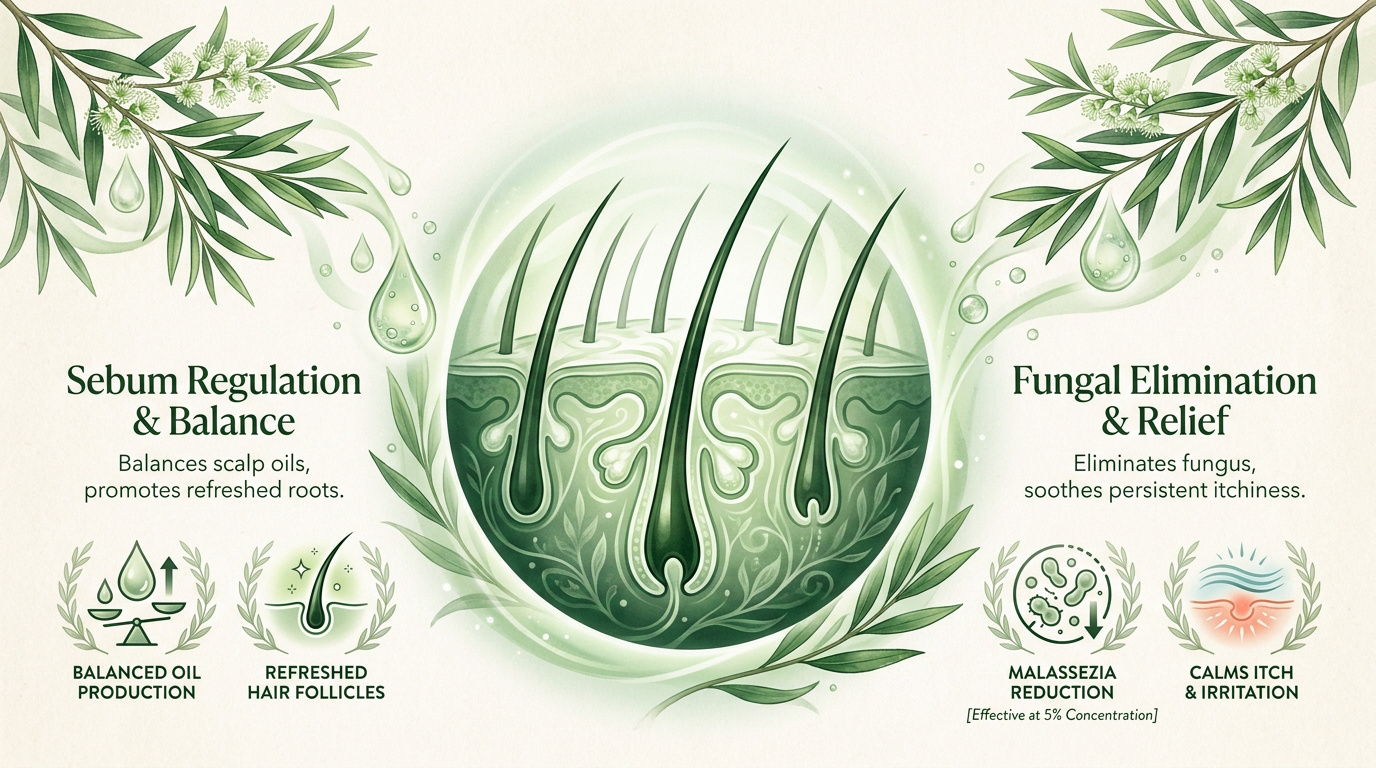
Many users notice a fresher, less itchy feeling from the first washes. Tea tree oil helps the scalp feel calmer, but dandruff that persists after a few weeks deserves a word with a pharmacist.
Can tea tree oil improve your daily oral hygiene?
Tea tree oil can play a small part in daily oral hygiene as a heavily diluted mouth rinse, because its purifying properties are of interest in the mouth too, but it is never swallowed and it does not replace brushing or a dentist.
Gums and mouth ulcers
Using tea tree oil in the mouth calls for precision. Dilute exactly one drop in a full glass of water and stir well. Use the mixture as a mouth rinse, then spit it all out. Some people use it this way when they have a mouth ulcer, for the clean, fresh feeling it leaves around the sore area.

The same rinse is traditionally used when gums feel tender. Laboratory tests show that the oil is active against some of the bacteria found in dental plaque. Rinsing regularly leaves the mouth with a noticeably cleaner feel. Bleeding or swollen gums are still a reason to see your dentist, whatever you rinse with.
Never swallow tea tree oil when you rinse. It is meant for contact with the surface of the mouth only. Always rinse your mouth with plain water afterwards.
Around the home and in a diffuser
Tea tree oil is also a simple addition to natural household cleaning. Add a few drops to water and white vinegar to make a fresh-smelling surface cleaner. It works well on kitchen worktops and bathroom tiles. It leaves a clean scent behind and no heavy residue.
We suggest these practical uses around the house:
- Wiping door handles as part of your routine to keep high-touch surfaces clean.
- Cleaning yoga mats after a hard session.
- Freshening laundry by adding a few drops to the drum.
- Freshening the air in a diffuser during the winter months.
A diffuser is the easiest way to enjoy the scent through the colder months. Diffusing tea tree oil for short periods in an aired room is a popular winter habit, though it should not be seen as protection against seasonal viruses.
| Benefit | How it is used |
|---|---|
| Oral care | Diluted mouth rinse, never swallowed |
| Home hygiene | Surface cleaning |
| Winter air | Short diffusion in an aired room |
Which carrier oil blends extend tea tree oil benefits?
The carrier oil blends that extend tea tree oil benefits are black seed, jojoba, rosehip and castor oil: each one dilutes the tea tree to a safe level and adds qualities of its own for a more targeted routine.
A purifying blend with black seed oil
Combine tea tree with black seed oil for a blend with a strong purifying character. It is well suited to blemish-prone skin that looks dull and uneven. Black seed oil (nigella) has its own traditional reputation as a soothing oil, which complements the tea tree.
The blend is often used on skin marked by old blemishes, to help it look more even. Keeping pores clean also makes new breakouts less likely. Apply a few drops as a night serum, on clean skin.
With regular use, the surface of the skin feels smoother. Enlarged pores look less obvious. The complexion looks more balanced and healthier overall.
Balanced moisture with jojoba and rosehip
Jojoba oil is the specialist when it comes to balance. Its structure is close to the skin's own sebum, so it moisturises without clogging pores. That makes it the ideal carrier for skin that is oily yet dehydrated, and jojoba oil lets you apply tea tree in a properly diluted, comfortable form.
We also suggest adding rosehip oil if ageing skin is your concern. It supplies essential fatty acids and vitamin A. Together they help skin feel more supple and make fine lines look softer.
| Carrier oil | Main benefit | Best for | What it adds to tea tree |
|---|---|---|---|
| Black seed | Purifying | Blemish-prone skin | Extra purifying action |
| Jojoba | Sebum balance | Oily or combination skin | Balanced moisture |
| Rosehip | Ageing skin | Marks and fine lines | Suppleness |
| Castor | Strength | Hair and nails | A cleaner scalp |
Hair and nails with castor oil
Tea tree also pairs well with castor oil. This thick oil coats and strengthens the hair fibre from the root. The tea tree leaves the scalp clean, so the castor oil can do its work.
Use a small brush to apply the blend to the base of the nails. It keeps the nail area clean and cared for while the nail grows. Brushed on sparingly, castor oil also makes lashes look thicker, but keep any blend containing tea tree well away from the eyes.
On the hair, apply the blend as a weekly mask. Leave it on for thirty minutes, then shampoo as usual.
Safety and storage rules that keep tea tree oil in good condition
Even the most natural products call for strict respect of a few safety rules if you want to avoid unwanted reactions.
Dilution rates and age limits
Diluting tea tree oil is what protects your skin. For large areas, keep to a concentration of 1% to 2%. In practice, that means five drops per tablespoon of carrier oil. This limits the risk of widespread irritation or sensitisation.
- Not suitable for children under 6.
- Avoid during the first trimester of pregnancy.
- Never apply inside the ear canal.
- Keep away from the eyes.
Always do a patch test first. Apply a little diluted oil to the inside of your elbow. Wait twenty-four hours and check for redness. This step matters for everyone, including people who have used other essential oils without any trouble.
Oxidation and how to spot an oil that has gone off
Light and heat speed up oxidation. The process produces para-cymene, a known irritant. Store your bottles somewhere cool and dark. How long the oil stays stable depends largely on these conditions.

You can recognise an oil that has gone off by its smell. A thicker texture or a cloudy look also points to degradation. Throw the bottle away as soon as you notice these signs. Using an oxidised oil puts your skin at real risk of a reaction.
Screw the cap back on firmly after each use. Oxygen degrades an essential oil a little more every time the bottle is left open.
A good tea tree oil, with more than 30% terpinen-4-ol, is a useful purifying addition to a skin, scalp and oral hygiene routine. Work it into your daily habits or your carrier oil blends in small, diluted amounts, and follow the precautions above. Used with care, it lets you enjoy these tea tree oil benefits and keep your routine short and simple.
FAQ
What are the main tea tree oil benefits?
Tea tree oil is best known as a purifying essential oil, with antibacterial and antifungal activity, and some antiviral activity, reported in laboratory tests. It is traditionally used in skincare for blemish-prone skin, in winter diffusion and in oral hygiene as a diluted mouth rinse. Its profile is dominated by terpinen-4-ol, the molecule that acts on the cell membranes of micro-organisms in those tests. It remains a cosmetic and household ingredient, not a medicine.
How should I apply tea tree oil to spots and blemishes?
For the occasional spot, put one drop of tea tree oil on a cotton bud and dab it directly onto the blemish twice a day. The oil helps to absorb excess sebum and has a purifying action on Cutibacterium acnes, the bacterium associated with blemishes, so the spot looks less red and raised. For sensitive skin or larger areas, we recommend diluting it in a carrier oil such as jojoba or black seed to limit the risk of irritation.
Can tea tree oil help with dandruff?
Tea tree oil can help a dandruff-prone scalp feel cleaner, because it shows antifungal activity against Malassezia, the yeast associated with dandruff. It is also used on oily scalps, where the build-up of sebum goes hand in hand with flaking. Adding a few drops to your usual amount of shampoo helps to purify the scalp, ease the itchy feeling and keep the scalp comfortable over time.
Is tea tree oil safe for oral hygiene?
Tea tree oil can be used in oral hygiene only as a heavily diluted rinse, where it is appreciated for leaving the mouth and gums feeling clean. Dilute one drop in a glass of water and use it as a mouth rinse. The key safety point: never swallow the mixture. It is meant for contact with the surface of the mouth only, and you should rinse with plain water afterwards.
What are the essential safety precautions and storage rules?
Safety comes first: tea tree oil is not suitable for children under 6 or during the first trimester of pregnancy. Always do a patch test and keep to a 1% to 2% dilution on large areas. To preserve the oil, store your bottle somewhere cool and dark, because oxidation produces para-cymene, which can cause skin sensitisation. If the oil turns cloudy or its smell changes, throw it away immediately.
Which carrier oils work best with tea tree oil?
The right blend depends on what you want from it. For blemish-prone skin, black seed oil brings a strong purifying character, while jojoba oil is ideal for balancing sebum. If your focus is hair or nails, castor oil coats and strengthens the fibre and keeps the nail area well cared for.