

Natural nail care: a simple routine to follow at home
Natural nail care is a long game: on average, a fingernail grows about 3.5 mm a month, or just over a tenth of a millimetre a day.
Water, household products and rough handling weaken this keratin plate, leading to peeling or breakage. This guide sets out the key steps of a simple routine you can follow at home to keep your nails in good condition month after month.
- Why does a natural nail care routine matter?
- How do you use Bon Sens organic cuticle oil?
- How do you give yourself a home manicure without damaging your nails?
- Protection and diet in natural nail care
Why does a natural nail care routine matter?
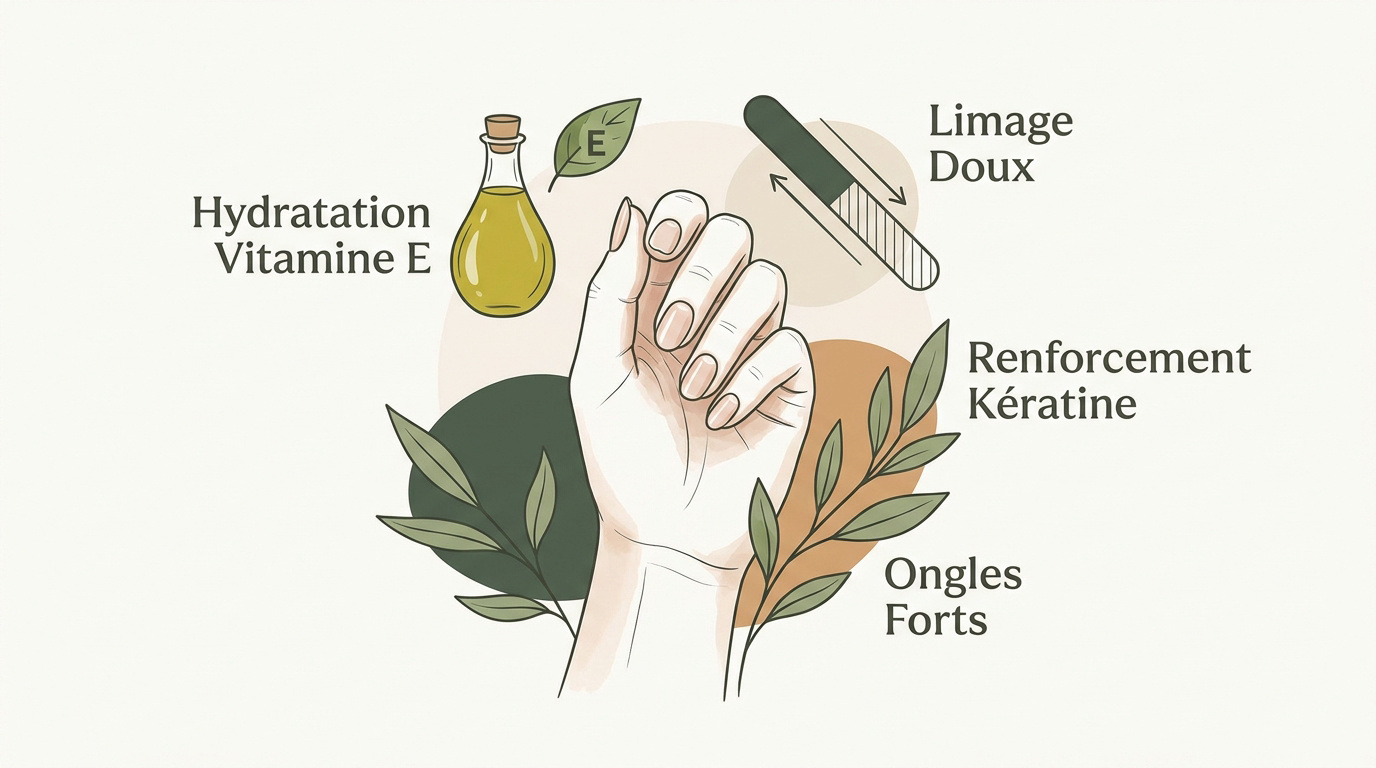
A natural nail care routine matters mainly because it limits what damages nails every day: water, detergents and rough handling. Moisturising the skin around the nail, filing in one direction and pushing cuticles back without cutting them are enough to start with, and they help you work out which nail type you have.
Simple steps repeated every day count for more than an occasional intensive session.
Identify your nail type to target what it needs
Start by telling apart soft nails, which bend, and brittle nails, which split or peel. Brittle nails are often linked to ageing or to long-term exposure to water or chemicals.
Too much water weakens nails, which can then split, peel or break: dermatologists at the AAD advise wearing gloves for the washing-up and moisturising after every hand wash. A cuticle oil or jojoba oil does the job.
Soft nails: they bend easily. Brittle nails: often ageing, water or chemicals. Vertical ridges: common with age.
Look at your bare nail under direct light. Ask yourself whether the weakness comes from the nail itself or from your daily habits.
Recognise warning signs on the nail plate
Small white spots are usually nothing to worry about. A yellow nail is most often linked to a fungal infection, nail psoriasis or very frequent use of nail varnish. Vertical ridges often appear with age and are not dangerous, whereas a nail that curves inwards like a spoon can go with iron-deficiency anaemia.
A nail takes several months to grow out completely: judge a routine over months, not over a week.
See your GP if your nails change in colour, texture, shape or thickness and you don't know why, or if they become painful.
How do you use Bon Sens organic cuticle oil?
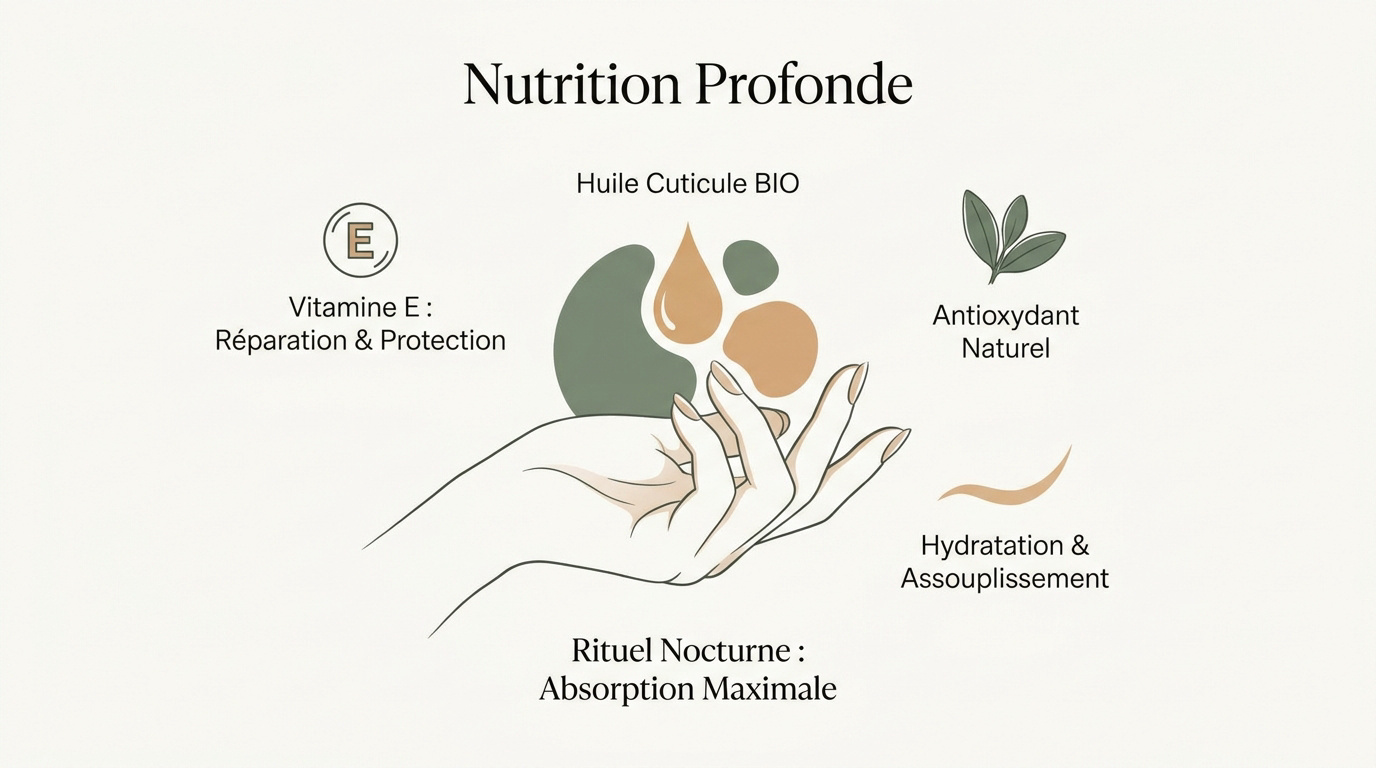
You use Bon Sens organic cuticle oil by brushing it onto the skin around each nail every evening, then massaging it in for a few seconds: it is the moisturising step of natural nail care, once you know what your nails need.
What vitamin E brings to the skin around your nails
The organic cuticle oil is enriched with vitamin E, an antioxidant. Applied around the nail, it nourishes the skin and leaves a film that limits dryness.
This cuticle oil comes in two scents, strawberry and vanilla. Its built-in brush makes application precise, with no greasy finish. Used every evening, it leaves cuticles feeling softer.

Here is what this oil does in practice:
- Vitamin E, an antioxidant.
- Moisture for the skin around the nail.
- Softer cuticles that are easier to push back.
Make it part of your evening routine
Apply one drop to each finger before bed. Massage it in gently. In the evening, the oil has time to work without being washed off.
Use a gentle circular massage, from the edges towards the base of the nail. It is also a good moment to spot a dry cuticle or a hangnail before it tears.
For variety, Bon Sens organic plant oils can also be used around the nail, for example castor oil, which is thick and easy to dab on with a fingertip.
How do you give yourself a home manicure without damaging your nails?
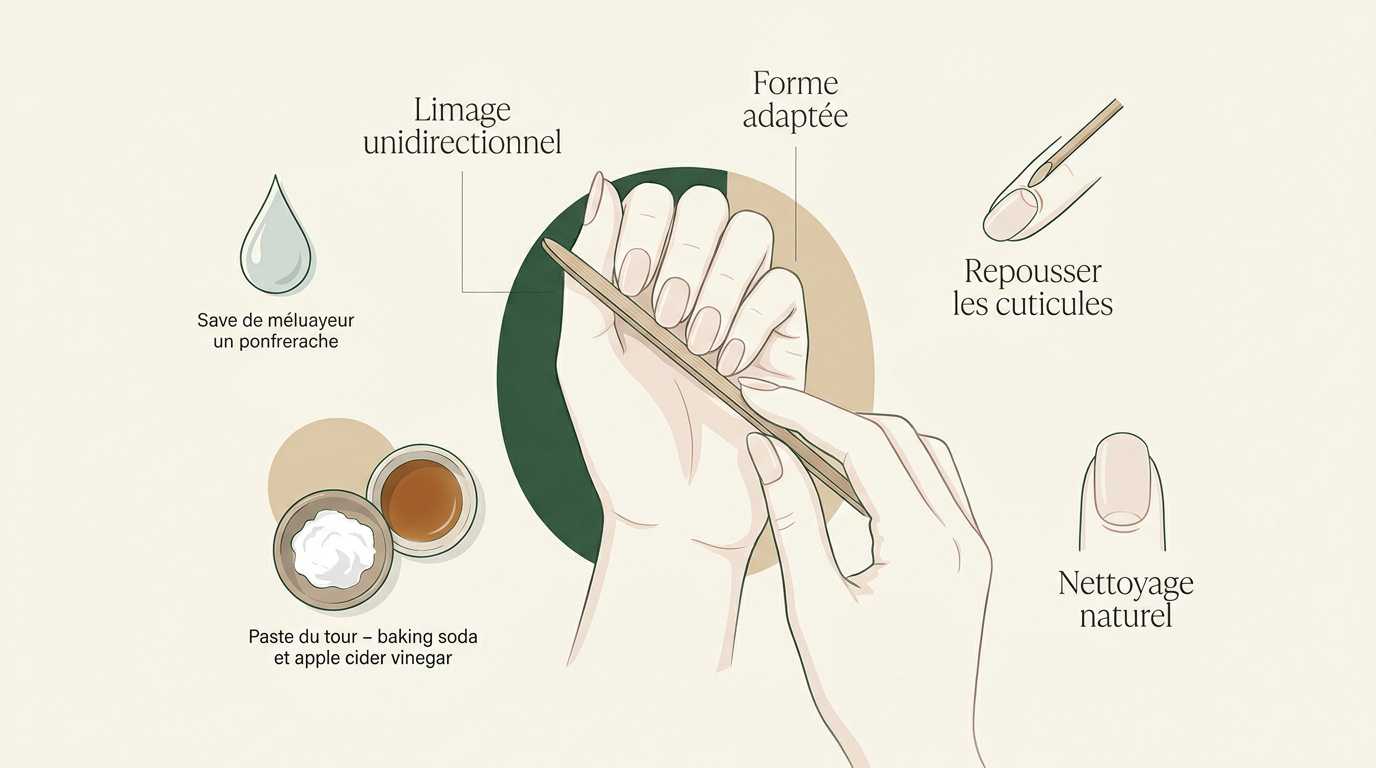
A home manicure without damage comes down to three steps: file in one direction, push cuticles back without cutting them and clean with gentle ingredients.
Master one-way filing and choose the right shape
Always file in the same direction rather than sawing back and forth. Use a fine-grit file for a gentler finish.
Choose a shape that suits your nails. An oval or rounded shape avoids corners that catch. A square shape suits naturally strong nails.
Check that both hands match. Never force the fragile corners.
Push back cuticles gently, never cut them
The cuticle protects the nail as it grows. Dermatologists advise against removing it, as this can damage the nail. Use a boxwood stick wrapped in cotton wool instead.
Soak your hands in warm water first to soften the skin. The gesture is then gentler.
Work with care. Respect this natural barrier.
Clean your nails with simple ingredients
A bicarbonate of soda paste is a common home tip for cleaning the nail surface. We found no study measuring its whitening effect, so use it gently, once a week at most. Rub lightly, then rinse thoroughly with clean water.
If a nail stays yellow after cleaning, do not try to buff it away: talk to your GP or pharmacist.
Bicarbonate paste: 1 tsp plus a little water, gentle massage for 1 min, then rinse. Moisturise afterwards with a drop of oil.
Protection and diet in natural nail care
Protection and diet round off external care: gloves for wet chores and a varied diet, without relying on supplements.
Which nutrients matter for healthy nails?
Biotin is often mentioned for brittle nails. Clinical trials have shown an improvement with oral biotin, but a 2018 review says larger controlled trials are needed. Some deficiencies, such as iron or zinc, can change how nails look: before taking any supplement, ask your GP or pharmacist.
| Nutrient | Food source | What we know for nails |
|---|---|---|
| Biotin | Egg yolk, almonds | Effect on brittle nails still to be confirmed |
| Iron | Red meat, lentils | A deficiency can cause spoon-shaped nails |
| Zinc | Seafood, seeds | A deficiency can cause white spots |
| Protein | Fish, pulses | Nail keratin is a protein |
Avoid common chemical and household damage
Wear gloves for cleaning and the washing-up. Moisturise your hands after every wash. Leave your nails free of varnish from time to time. These simple precautions protect your nails every day.
Water weakens the nail plate. Dry your hands thoroughly. Avoid needless knocks.
Plan your care between daily and weekly steps
Moisturise your cuticles every evening. That is the one daily step not to skip. File only once a week.
Every evening, follow this order:
- Apply the oil
- Massage the skin around the nail
- Check the edges
- Take a break from varnish
Start tonight with the simplest step: one drop of oil on each cuticle. Weekly filing and gloves for household chores are easy to add afterwards. Allow several months before judging the results: that is how long it takes a nail to grow out.
Natural nail care FAQ
How do I set up an effective nail care routine at home?
To set up a nail care routine at home, combine three steps: moisturising, filing and protecting. Every evening, moisturise your cuticles with a cuticle oil or a plant oil such as castor oil or sweet almond oil, then massage gently.
Once a week, file in one direction. Wear gloves for the washing-up and cleaning. Consistency matters more than intensity: a nail takes several months to grow out.
What are the natural ways to strengthen soft or brittle nails?
Organic plant oils are a simple answer to fragile nails. Castor oil is thick and easy to apply to the nail and the skin around it to nourish it, and a five-minute soak in warm olive oil leaves cuticles feeling softer.
Protection matters just as much: too much water weakens nails. Gloves for household chores and moisturising after every hand wash limit repeated damage.
Which nutrients should I focus on for nail growth?
A varied diet provides the nutrients nails need: protein, iron, zinc and biotin (vitamin B7), found in eggs, nuts, pulses, seafood and fish. An iron or zinc deficiency can change how nails look.
Studies on biotin supplements show encouraging results for brittle nails, but they still need to be confirmed. Before taking a food supplement, ask your GP or pharmacist, especially if you suspect a deficiency.
Why shouldn't you cut your cuticles during a manicure?
You shouldn't cut your cuticles because the cuticle protects the nail as it grows. Dermatologists advise against removing it, as this can damage the nail.
Instead, soften the skin in warm water, then gently push it back with a boxwood stick wrapped in cotton wool. This gentle technique keeps the cuticle intact while giving a neat outline.
How do you bring whiteness and shine back to yellowed nails?
A yellowed nail most often comes from a fungal infection, nail psoriasis or very frequent use of nail varnish. If varnish is the cause, a break between coats and a gentle clean with a bicarbonate of soda and water paste are common home tips, but we found no study measuring their effect.
If the colour persists, or the nail changes shape or thickness, do not try to whiten it yourself: see your GP or pharmacist.