

Jojoba oil for hair: benefits for your hair and scalp
- Jojoba oil is a liquid wax whose structure resembles that of sebum, which explains its light, non-greasy feel when you use the right amount.
- Applied regularly to the lengths, it lubricates the hair fibre: easier detangling, smoother ends and more shine.
- Once or twice a week is enough for most hair types.
- A 24-hour patch test lets you check your skin tolerates it, and any essential oil you add must be diluted.
The benefits of jojoba oil for hair come down to its composition: a liquid wax, quite unlike conventional plant oils. Yet many hair products weigh hair down or leave the scalp greasy by the end of the day.
This guide explains what jojoba oil really does for your hair and scalp, what it does not do, and how to apply it. Every figure links to its source.
- Organic jojoba oil for hair: a liquid wax close to sebum
- What are the real benefits of jojoba oil for hair?
- How do you use jojoba oil for hair in your routine?
- What does jojoba oil do for each hair type?
- Jojoba oil for hair: facts and myths
Organic jojoba oil for hair: a liquid wax close to sebum
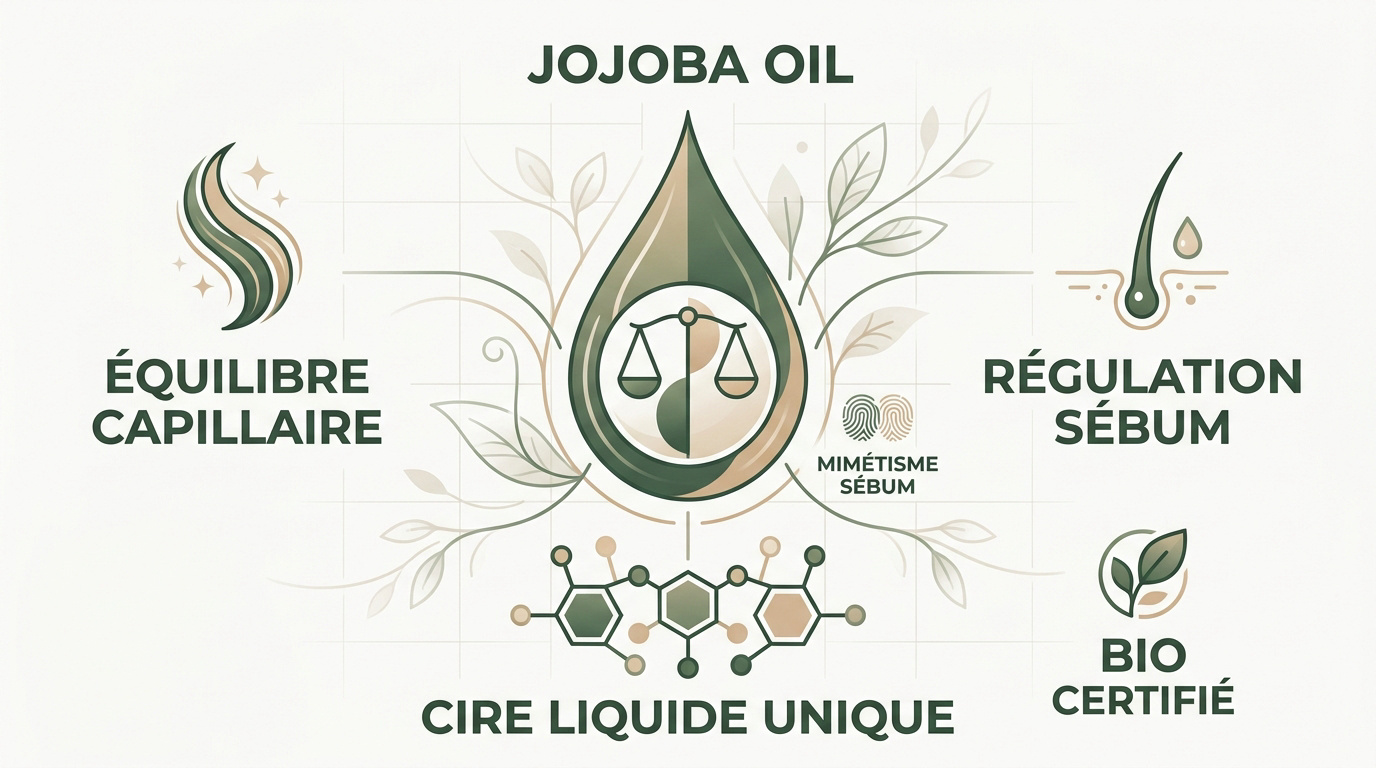
Jojoba oil is made of almost 98% waxes, mainly wax esters, with very few triglycerides. That is why it is described as a liquid wax rather than an oil.
Jojoba oil is a liquid wax extracted from the seeds of Simmondsia chinensis. Its structure is close to that of sebum, the natural oil your skin produces.
A unique composition that resembles human sebum
Jojoba oil is a plant-based liquid wax. It is made of wax esters and long-chain fatty acids. Its structure is clearly different from conventional oils, which are mostly triglycerides.
Human sebum also contains wax esters. A scientific review highlights this structural similarity with sebum, along with a smoothing effect on dry skin.
Its fluid texture sinks in quickly without leaving a greasy film, as long as you use only a little. That is a clear difference from thicker oils.
Why choose cold-pressed, certified organic oil
First cold pressing is a mechanical extraction of the seeds, with no solvent such as hexane. It is the process used for Bon Sens jojoba oil.

Our organic jojoba oil is certified by Ecocert to European organic farming standards. Its ingredient list fits on one line: 100% Simmondsia chinensis seed oil.
It is bottled in France in a glass bottle, with no added fragrance or preservative. What the ingredient list says is therefore easy to check.
Rich in waxes and low in triglycerides, jojoba oil shows good resistance to going rancid.
This stability is described in a review on jojoba: the oil keeps well when stored away from heat and light.
What are the real benefits of jojoba oil for hair?
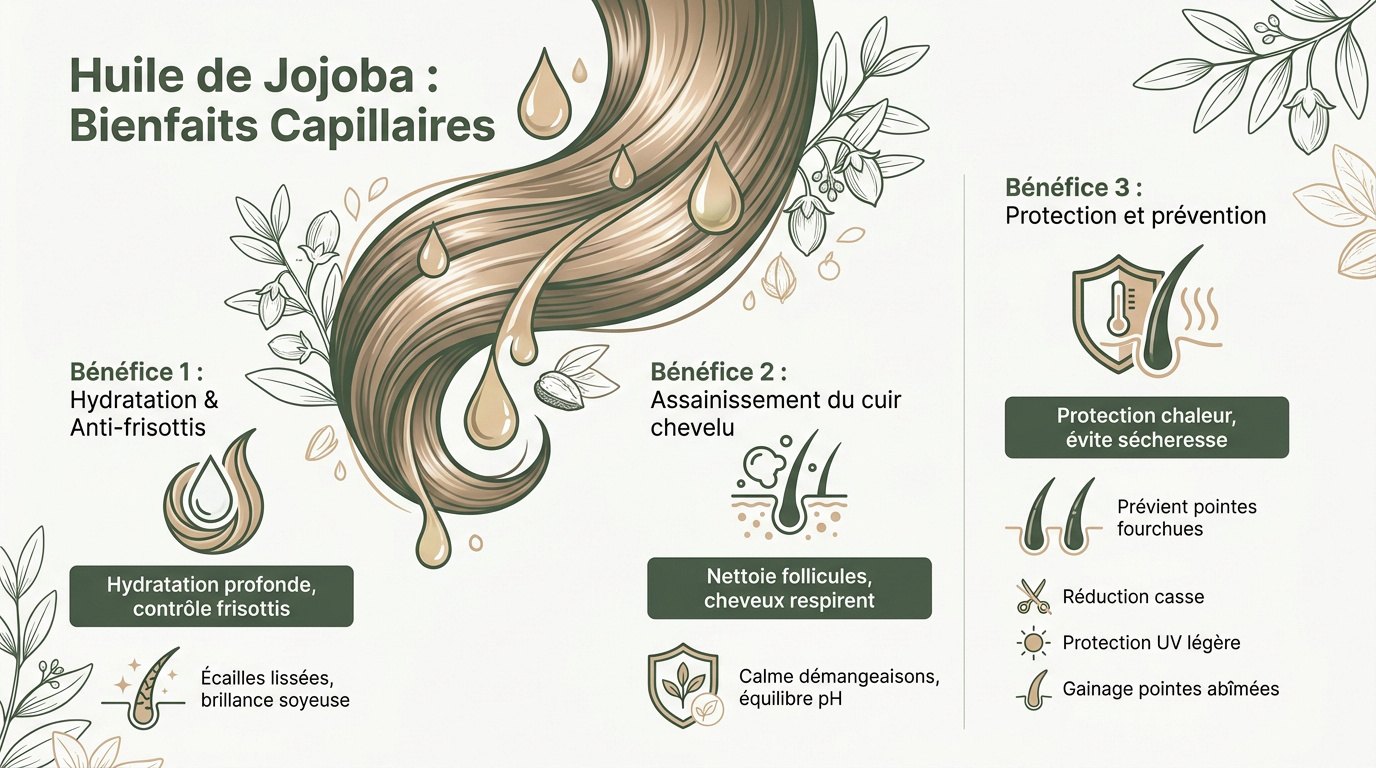
The real benefits of jojoba oil for hair are mostly cosmetic: it lubricates the hair fibre, adds shine, makes detangling easier and leaves hair softer to the touch.
Moisture and frizz control
Jojoba oil forms a very thin film around each hair. This film eases the feeling of dry hair and makes the fibre more supple to the touch.
It smooths the surface of the hair. Light reflects off it better, which gives visible shine as soon as you apply it.
This light film also helps tame frizz in damp weather. Your style holds better, without a stiff finish.
The scalp: what you can expect
Used as a pre-wash oil treatment, jojoba oil helps loosen excess sebum and styling product build-up. The wash that follows then removes it more easily.
On dry skin, studies describe a smoothing effect and less visible flaking, linked to its similarity to sebum. On the scalp, this mainly translates into a feeling of comfort. If itching or patches persist, ask a doctor or pharmacist for advice.
For a fresh feeling, you can add tea tree oil to your jojoba, never neat on the scalp: 3 drops at most in a tablespoon (15 ml) of jojoba oil, which is about 1%. Do a patch test in the crook of your elbow 24 hours beforehand, keep it away from your eyes, and avoid it during pregnancy, while breastfeeding and on young children. It can cause redness or irritation in some people, especially if the bottle is old. Store it out of reach of children and pets.
Damaged ends and breakage
An oil applied regularly lubricates the fibre: the comb catches less, the ends are smoother and split ends form less readily. Jojoba oil, being fluid, is well suited to this.
Less friction when detangling means fewer broken hairs. Your ends also stay more supple.
- Easier detangling
- Smoother ends
- Natural shine
How do you use jojoba oil for hair in your routine?
You can use jojoba oil for hair in four ways: as a pre-wash oil treatment, for a scalp massage, as a leave-in or mixed into your shampoo. Getting the amount right matters more than how often.
Pre-wash oil treatment and scalp massage
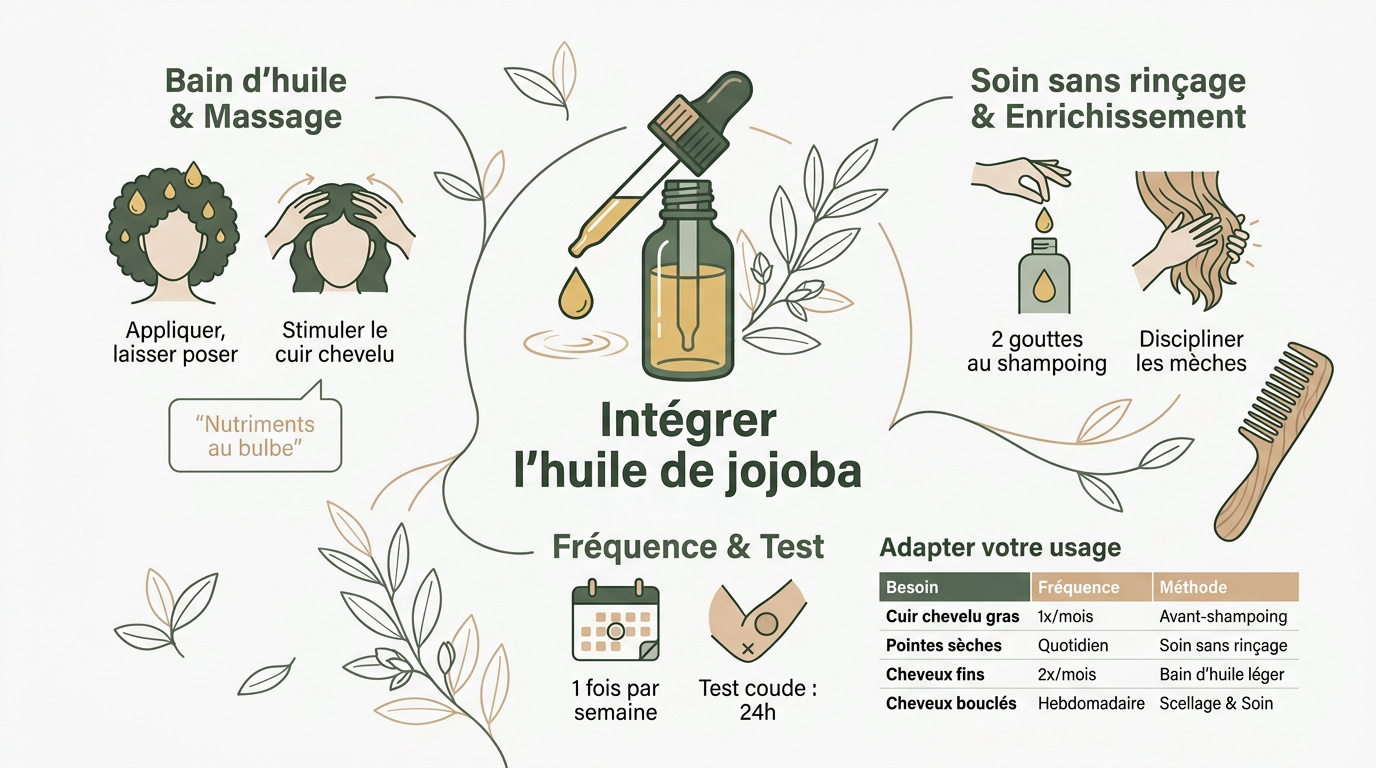
Apply the oil to dry lengths. Leave it on for thirty minutes, under a warm towel if you like. The warmth makes the oil more fluid and easier to spread.
Massage your scalp with your fingertips, using slow, circular movements. The massage spreads the oil and gives you a relaxing moment before you wash.
A gentle massage is enough: there is no need to rub hard to spread the oil well.
Leave-in care and adding it to your usual products
You can also add it to the products you already use. Mix two drops into your usual amount of shampoo, for a wash that feels gentler.
As a finish, put one or two drops on damp hair to tame flyaways. It is also a handy way to slick hair back with a neat finish.
How often to use it, and the patch test
Once or twice a week is enough for most hair types. More than that and the oil may weigh your hair down. Watch how your hair reacts after each treatment and adjust using the table below.
Before first use, put a drop in the crook of your elbow. Wait twenty-four hours: if there is no redness or itching, you can use it. This patch test reduces the risk of irritation.
| Hair need | How often | Method |
|---|---|---|
| Oily scalp | Once a week at most | Pre-wash massage |
| Dry ends | Once or twice a week | Finish (1 to 2 drops) |
| Fine hair | Once every 2 weeks | Oil treatment on the lengths |
| Curly hair | Once or twice a week | Leave-in |
What does jojoba oil do for each hair type?
What jojoba oil does depends on your hair type: shine without weight for fine hair, definition for curls, softness for coloured hair. Only the amount changes.
What curly, dry or fine hair needs
For fine hair, less is more. One or two drops on the lengths is enough. The aim is to nourish without losing volume.
For curly hair, apply the oil after your moisturising product, on damp hair. It helps keep curls better defined and limits a fluffy look.
For dry hair, a pre-wash oil treatment is the most useful step. It adds softness without leaving residue after washing.
Caring for coloured and chemically treated hair
Colouring and chemical straightening often leave hair more porous and rougher. A few drops of jojoba oil on the lengths make it softer to the touch again.
A review on jojoba reports a beneficial effect on the hair fibre when the oil is added to a chemical straightening emulsion. For home care, apply it a few days after colouring, on clean hair.
What you can expect:
- Shine
- Softer feel
- Easier detangling
Useful blends with other plant oils
Jojoba oil blends well with other oils. Combined with castor oil, which is very thick, it makes a more fluid blend that is easier to spread over the lengths.
If you add tea tree essential oil for a fresh feeling, stick to a dilution of about 1% (3 drops at most per 15 ml of jojoba oil) and follow the precautions above.
For very dry, dull hair, an equal mix of jojoba and castor oil, used as a pre-wash treatment, adds shine and softness.
Jojoba oil for hair: facts and myths
The facts about jojoba oil for hair are simple: it makes the hair fibre look and feel better, and it does not make hair grow. Here is what is established and what is marketing.
Jojoba vs coconut oil, and the question of hair growth
Coconut oil, rich in lauric acid, is able to penetrate the fibre of the hair. For jojoba oil, which is mostly waxes, no comparable measurement has been published as far as we know: it is mainly used as a surface treatment.
No oil makes hair grow. However, an oil that lubricates the fibre helps limit breakage, which can help you keep more length.
Hair that breaks less looks fuller. It is a visual effect, not faster growth.
No study shows that jojoba oil speeds up hair growth. It can limit breakage caused by friction, which helps you keep your length.
Using too much, and getting rid of greasy residue
Heavy or dull hair is a sign. You have probably used too much oil. Overdoing it weighs the fibre down and dulls it instead of improving it.
Work your shampoo into a good lather before rinsing. Lukewarm water dissolves oils better than cold water. Two gentle washes are better than one harsh one.
Read our guide on removing hair wax for stubborn cases: the same method works for too much oil.
Key points: jojoba oil is a liquid wax close to sebum that adds shine, softness and easier detangling. It does not make hair grow, but it helps limit breakage. Use a small amount, once or twice a week, and always do a patch test before first use.
FAQ
Why is jojoba oil said to resemble the sebum on our scalp?
Jojoba oil resembles sebum because it is made of almost 98% waxes, mainly wax esters, a family of lipids also found in human sebum. Unlike conventional plant oils, it contains very few triglycerides.
This similarity explains its light texture: used sparingly, it leaves no greasy film on the hair or scalp.
What does jojoba oil actually do for dry, damaged hair?
On dry, damaged hair, jojoba oil lubricates the fibre: detangling is easier, the ends are smoother and shine comes back. By reducing friction, it helps limit breakage.
It does not repair damaged hair from within. Its effects are cosmetic and last until your next wash, which is why regular use makes sense.
Is jojoba oil suitable for oily roots?
Yes, jojoba oil is suitable for oily roots if you use only a little, even though no study shows that it changes sebum production. Being fluid, it leaves no greasy film in small amounts.
As a pre-wash oil treatment, once a week at most, it helps loosen excess sebum and styling product build-up, which the wash then removes. If itching or patches persist, ask a healthcare professional for advice.
What is the best way to apply jojoba oil to my hair?
The best way to apply jojoba oil for a full treatment is a pre-wash oil treatment: apply it to dry lengths and leave it on for 30 to 60 minutes. You can also use it as a leave-in, one or two drops on damp hair, to add instant shine.
For the scalp, warm a few drops between your hands and massage gently before washing. Once or twice a week is enough for most hair types.
Does jojoba oil really help hair grow?
No, jojoba oil does not make hair grow faster: no study shows that it does. By limiting breakage caused by friction, it can however help you keep more length.
Hair that breaks less looks fuller. It is a visual effect that fades if you stop using it.
Do you need certified organic, cold-pressed jojoba oil?
It is not essential, but it is the clearest choice. First cold pressing is a mechanical extraction with no solvent, and organic certification confirms that the seeds are grown to organic farming standards.
Check the ingredient list: a pure jojoba oil contains just one ingredient, Simmondsia chinensis seed oil. That is the case for Bon Sens oil, certified by Ecocert.