



Black seed oil for hair: how to use it, how much, and what to expect
- Black seed oil for hair: no published study shows that it makes hair grow. It coats the hair fibre, leaving it more supple and glossier.
- Two ways to use it: 5 to 10 drops massaged into the scalp, or 1 to 3 teaspoons as a pre-wash oil treatment, once a week, diluted with jojoba to tone down the smell.
- Before you start: a 48-hour patch test in the crook of the elbow (contact allergy is documented), never the essential oil neat, and caution with oral use during pregnancy and breastfeeding.
You searched for "black seed oil for hair" because a bottle is waiting in the cupboard (the same oil is sold as kalonji oil or nigella oil). Here is the method with quantities, a timeline based on the hair cycle, the precautions, and a straight answer on growth.
- How do you apply black seed oil to your hair?
- Black seed oil for hair: how much, and how many uses in a 50 ml bottle?
- Does black seed oil make hair grow?
- Black seed oil for hair before and after: what can you expect to see, and when?
- Strong smell, greasy roots, afro hair: what to mix black seed oil with
- What are the downsides of black seed oil?
- Black seed oil for hair: which oil to choose and how to store it?
- Before you start
How do you apply black seed oil to your hair?
You apply black seed oil to your hair in one of two ways: a few drops massaged into the scalp, or a pre-wash oil treatment on the lengths, left on for 30 minutes to an hour and then washed out.
On the scalp: a few drops, parting by parting
On dry hair, place 5 to 10 drops of black seed oil along several partings, massage for 2 to 3 minutes with your fingertips, leave for 30 minutes, then wash with a mild shampoo. Not on a scalp that is irritated or covered in flaky patches: in that case, ask a pharmacist or your GP first.

As a pre-wash oil treatment: on the lengths, before shampooing
- Detangle your hair while it is dry.
- Pour the amount from the table below into a small dish and warm it between your palms.
- Apply from mid-lengths to ends: as with a rich conditioner, a review of hair cosmetics advises keeping oily treatments on the lengths so the hair is not weighed down.
- Leave on for 30 minutes to an hour under a shower cap.
- Rinse out with one or two washes of a mild shampoo.
How often: once a week as an oil treatment, once or twice a week on the scalp, and 6 to 8 weeks before you judge. Every day is not the rule: the smell, greasy roots and a known allergen all argue against it. The weekly oil treatment is described step by step in our full routine with jojoba oil.
Black seed oil for hair: how much, and how many uses in a 50 ml bottle?
For hair, count 5 to 10 drops of black seed oil on the scalp, 1 teaspoon (5 ml) as an oil treatment on short hair, 2 on mid-length hair and 3 on long hair: a 50 ml bottle covers anything from 3 neat oil treatments to 100 to 200 scalp applications.
These figures rest on a common equivalence, 1 teaspoon for 5 ml and roughly 20 drops per millilitre: an order of magnitude, not a precise measure. Pour according to the cap on your own bottle, into a small dish.
| Use | Hair length | Amount | Applications per 50 ml bottle |
|---|---|---|---|
| Scalp only | Any | 5 to 10 drops (0.25 to 0.5 ml) | 100 to 200 |
| Neat oil treatment | Short | 1 teaspoon (5 ml) | 10 |
| Neat oil treatment | Mid-length | 2 teaspoons (10 ml) | 5 |
| Neat oil treatment | Long or thick | 3 teaspoons (15 ml) | 3 |
Does black seed oil make hair grow?
No published study shows that black seed plant oil makes hair grow, reduces shedding or increases the number of hairs.
PubMed contains no study on black seed plant oil and hair. The only study quoted elsewhere is a pilot study from 2013: 20 women, a lotion of 60% alcohol containing 0.5% black seed essential oil, contradictory results and no statistics. That is not the oil in your bottle.
Oils form a lubricating film over the cuticle that increases shine, reduces friction and limits breakage. Rich in linoleic acid, like sunflower oil, black seed oil probably penetrates the fibre very little and works mostly on the surface: a cosmetic effect.
That is why you will not read "strengthens" or "stimulates" here: European regulation demands supporting evidence for any claim. The hairs falling out this week entered their resting phase about three months ago: no oil applied today changes that. Marked or sudden hair loss is something to show your GP, not an oil.
Black seed oil for hair before and after: what can you expect to see, and when?
Black seed oil changes how hair looks from the first treatment (suppleness, shine), but a hair spends 2 to 7 years growing and about 3 months resting before it falls out: any judgement on density before several months have passed is premature.
Those durations come from a 2020 review of the hair follicle; the oil settles on the hair shaft, not on the follicle.
| When | What you can expect to see | What it proves |
|---|---|---|
| Day 1 | Softer, glossier hair, the smell gone once rinsed | A cosmetic effect, until the next wash |
| Weeks 6 to 8 | Fewer broken hairs in the brush | To compare against your reference photo |
| Month 3 | The hairs falling out were already resting before your first treatment | Nothing to credit the oil with |
| Month 4 onwards | One resting cycle has passed | No study has measured density |
Take your own reference photo
We have no photo and no testimonial, and we will not invent one. Take your own on day 1 and in week 8, same light, same angle: compare the shine and the broken hairs, not the length.
Strong smell, greasy roots, afro hair: what to mix black seed oil with
The spicy smell comes from the volatile fraction of the seed (p-cymene, thymoquinone), which makes up 0.5 to 1.6% of the seed, and it goes once rinsed. Three levers: dilute, apply in the evening, rinse.
To dilute, jojoba oil half and half is the simplest blend: more fluid, the smell toned down, suited to fine hair and roots that get greasy quickly.

Black seed and castor oil mask for dry lengths
Mix 1 teaspoon of each, apply from mid-lengths to ends and leave on for an hour under a shower cap. Castor oil is thick: allow two mild shampoos, and see our guide to castor oil for rinsing and the LOC method.
Afro and curly hair
The cuticle of afro hair is thinner, so it is more prone to breakage. Apply the blend to damp hair, section by section, concentrating on the ends, for an hour to overnight.
What are the downsides of black seed oil?
The downsides of black seed oil on hair come down to four points: it can cause a contact allergy, it gets confused with black seed essential oil, which is never applied neat, it smells strong and weighs down the roots, and it oxidises quickly.
The contact allergy is documented: three women admitted to hospital in France with severe acute contact dermatitis after applying black seed oil (2018), thymoquinone identified as the allergen (2020), five new cases in 2021 and one case of a partner sensitised by beard cosmetics in 2023. Hence the 48-hour patch test, and stopping at the first sign of redness.
Plant oil or essential oil: two different products. The seed yields 35 to 42% fixed oil, the one in your bottle, and 0.5 to 1.6% essential oil, which concentrates 30 to 48% thymoquinone and is never applied neat. The ingredient to expect on the label is "Nigella Sativa Seed Oil", the fixed oil of the seeds according to CosIng, an emollient and fragrance ingredient according to COSMILE Europe.
Black seed oil for hair: which oil to choose and how to store it?
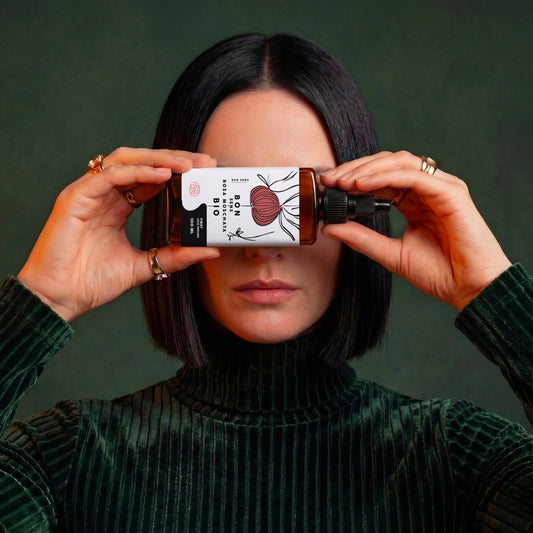
For hair, choose a virgin black seed oil, 100% pure, first cold pressed, certified organic, in a small UV-protective glass bottle, and use it within the months that follow opening.
A single ingredient rules out any added essential oil, and cold pressing best preserves the fatty acids. The small size and the glass answer this oil's weak point: with 50 to 60% linoleic acid, its oxidative stability is low and highly variable from one batch to the next; its acidity and smell had changed within four months at 4 °C in a 2023 study.
In practice: cap closed, away from light and heat, never warmed beyond lukewarm, thrown away if it smells rancid. The period after opening appears under the open-jar symbol required by the European cosmetics regulation.
Our organic plant oils: black seed, jojoba, castor and rosehip.

Before you start
Seven precautions that most pages leave out.
- Patch test: a trace in the crook of the elbow, 48 hours, no redness, even if you already use the oil on your face. Redness, itching or a blister: rinse, stop, and see your GP if the reaction spreads.
- Black seed essential oil and black seed plant oil are two different products: only the plant oil goes on neat.
- Not on an irritated or broken scalp, and not straight after colouring or chemical straightening.
- Pregnancy and breastfeeding: no data on use on the hair; by mouth, no data on transfer into breast milk and caution advised during pregnancy. Ask a pharmacist or your GP.
- Children: no oil treatment without professional advice.
- Do not swallow it without advice, especially if you are on any medication: oral use is outside the scope of this article.
- Side effect: tell your pharmacist or report it through the cosmetovigilance scheme.
FAQ
Black seed, castor or jojoba oil: which one for what?
None of the three has been shown to have any effect on growth. Black seed oil suits the scalp and blends, castor oil coats dry lengths, jojoba oil thins the mix.
Can you put black seed oil on your hair every day?
No: once a week as an oil treatment, once or twice a week on the scalp. Every day multiplies the smell, the grease and your contact with a documented allergen.
Can you leave black seed oil in your hair overnight?
Yes, after a patch test with no reaction, diluted with jojoba oil, under a shower cap, with a towel on the pillow. Not the first time, and not on a sensitive scalp.