

Black seed oil for face: benefits, evidence and how to use it
Contents
Can using black seed oil for face care really do your skin any good?
Results obtained with formulated skincare products cannot confirm the claims made for the pure oil. This guide sets out what the data lets you reasonably expect, and how to decide whether black seed oil belongs in your routine without overlooking the risks.
Black seed oil for face: what should you know first?

The first thing to know about black seed oil for face care is that the evidence is thin, and most of it concerns formulated products. For reference, Bon Sens Organic Black Seed Oil costs €9.99, and its description says it soothes, purifies and regenerates the skin.
Black seed oil comes from the seeds of Nigella sativa, also known as black cumin. Studies on facial skin are few. They mostly look at formulated products, not at the pure oil.
An extract, a plant oil and an essential oil differ in composition and in use. A 1% gel therefore cannot tell you whether the pure oil will have the same effect.
What does black seed oil contain?
Black seed fixed oil contains mostly fatty acids. Thymoquinone, by contrast, sits mainly in the volatile part of the seed. The effects studied for that molecule do not necessarily apply to the oil sold as skincare.
| Compound or family | Share observed in the oils | What it tells you |
|---|---|---|
| Linoleic acid | About 53 to 62% of the fatty acids | The main polyunsaturated fatty acid. It plays a part in the skin's barrier function |
| Oleic acid | About 21 to 26% | A monounsaturated fatty acid, linked to the oil's emollient properties |
| Palmitic acid | About 12 to 13% | A saturated fatty acid naturally present in the seed |
| Stearic acid | About 2 to 4% | A minor component of the fatty fraction |
| Thymoquinone | About 0.07 to 1.88% in the commercial preparations studied | A molecule studied for its antioxidant and inflammatory effects. Its level varies widely |
A fixed oil, an extract, a gel and a lotion do not share the same composition. You cannot use them as if they were interchangeable.
What the studies show, and what they do not
- Fewer acne lesions: low to moderate evidence, one controlled trial. 60 people aged 14 to 35 used a standardised hydroalcoholic black seed gel, compared with a placebo, twice a day for 60 days.
- Less acne: low evidence, single-blind trial. 93 people aged 13 to 23 used a lotion containing 10% oil, compared with a control lotion, twice a day for 8 weeks.
- Hand eczema: low evidence, controlled trial. 60 adults aged 18 to 60 used a 2% ointment, compared with Eucerin and betamethasone. The dose was 1 g twice a day for 4 weeks.
- Vitiligo: very low to low evidence. 52 people used black seed oil, compared with fish oil, twice a day for 6 months.
- Warts: very low evidence. 291 adolescents used a crude extract in an ointment, at 30 g twice a day for 6 weeks.
- Psoriasis: very low evidence. 60 people used a 10% ointment, an oral powder or the two combined for 12 weeks.
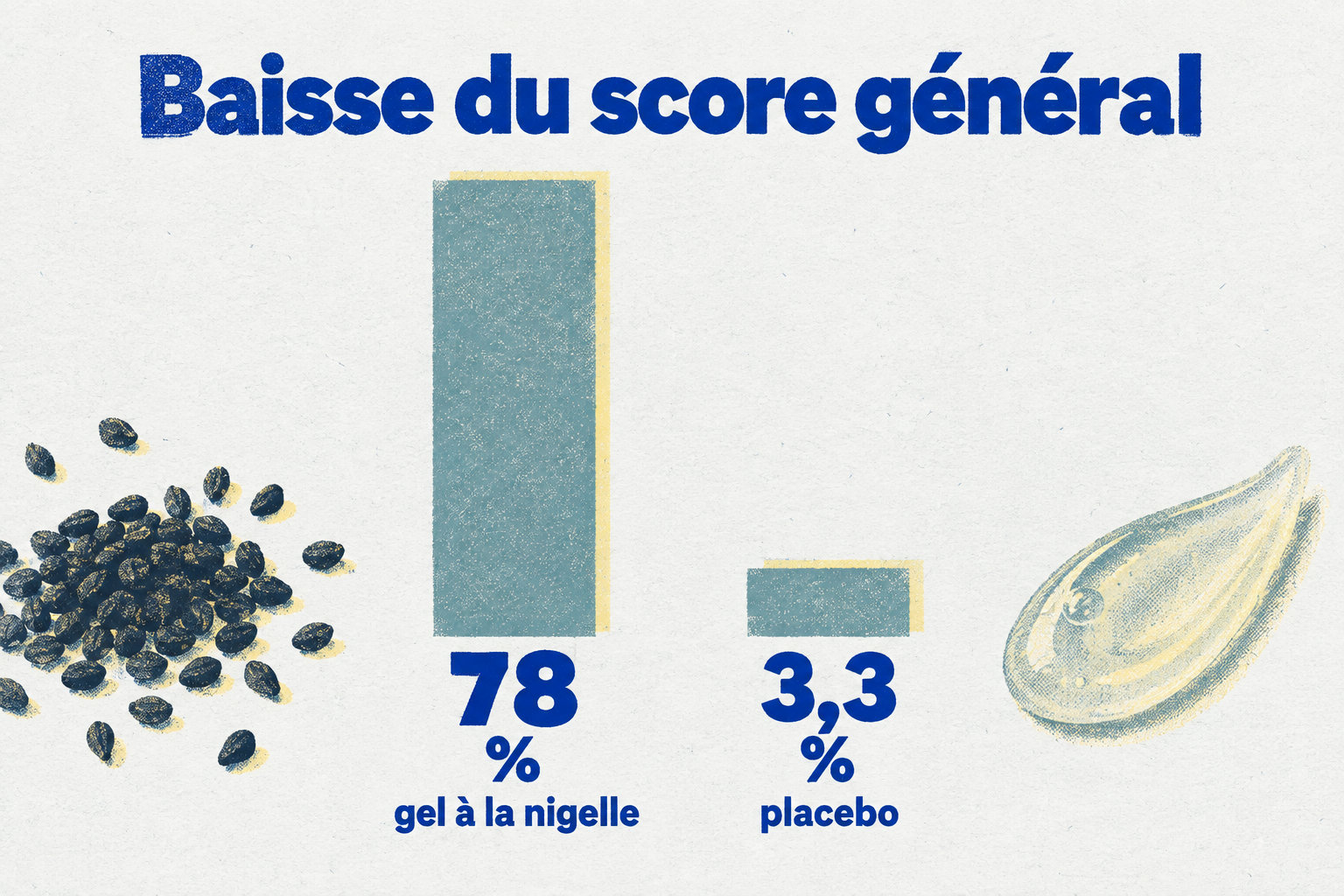
In the trial of the 1% gel, the overall score assessed by a dermatologist fell by 78% with the black seed gel. With the placebo, it fell by 3.3%. The gel was standardised. It was not a pure cosmetic oil.
With the 10% lotion, 25 people out of 47 saw a good improvement. In the control group, 3 people out of 38 did. The lotion contained ingredients other than the oil, so the result does not measure the effect of the oil alone.
How do you apply black seed oil to your face?
There is no dose of pure black seed oil that suits every face. The trials use doses and preparations that do not necessarily match your own routine.
Before putting any on your face, do a patch test on a small area.
- Dab a little of the product on a discreet area, such as the crook of your elbow.
- Wait 24 to 48 hours and check that there is no redness, itching, swelling or blistering.
- If your skin tolerates it, try a very small amount on a limited area of your face.
Avoid the eyelids, the skin right around the eyes, the lips and any irritated or damaged skin. If your skin is sensitive, choose an oil diluted in a neutral base over the pure oil.
What reactions can black seed oil cause on the face?
Black seed oil can make your skin redden, sting, itch or come out in small spots. This can be a sign of irritation or contact dermatitis. The reaction can appear several hours after you apply it.
Rare serious reactions have been reported, such as widespread patches or blisters. Tests have shown that some people react to the oil. Thymoquinone is one of the suspected components.
If your skin reacts, stop applying the oil and rinse the area gently. Seek medical advice promptly if the redness persists, if blisters appear or if the rash spreads. If you have trouble breathing or swell up quickly, call 999.
In the studies, reactions were sometimes poorly described and the groups were too small to pick up rare allergies. Few adverse effects on the skin were recorded.
These findings mostly concern oil applied to the skin. They do not prove that the oil is safe to swallow, nor that drinking it improves the skin. If you take medication or are thinking of swallowing the oil, ask a healthcare professional for advice.
How do you choose a black seed oil for face care?
To choose a black seed oil for face care, check four things rather than the claims:
- The INCI list and the stated use
- The botanical name and the volume
- The origin of the seeds and the extraction method
- The batch number and the storage instructions
"Cold-pressed" describes an extraction method. "Organic" indicates a certified production method. Neither term proves any effect on acne, wrinkles or dark spots. The origin does not guarantee a precise thymoquinone content either.
If you want to try black seed oil, check that it is intended for the face and test it in the crook of your elbow first. After 24 to 48 hours with no reaction, apply a very small amount to a limited area of your face. Stop if your skin reacts.
Frequently asked questions
Do results show quickly?
The acne trials followed participants for eight weeks or 60 days, so a single application cannot give you a reliable result. A quick improvement does not prove that the oil is acting on the cause of the problem either.
Can black seed oil replace a dermatology prescription?
No, do not swap prescribed medication for black seed oil without advice from a healthcare professional. The groups studied are small and the preparations are specific ones, not necessarily pure oil.
Can black seed oil cause a reaction all over the body?
Yes, it is rare, but severe and widespread skin reactions have been described after the oil was applied to one area. Stop using the oil and seek medical advice promptly if a rash spreads beyond the area where you applied it, if blisters appear or if your face swells.
Can you use black seed oil on skin that is already irritated?
It is better to wait until your skin is back to its usual state. On damaged skin, a reaction to the oil can be harder to recognise and can delay appropriate care.
Is black seed oil always rich in thymoquinone?
No, the thymoquinone content of black seed oil varies with the seeds, their origin, the extraction and the storage. Without a batch analysis or a stated standardised concentration, you cannot know the exact content of your oil.