

Peppermint oil for migraines: use and precautions
Peppermint oil for migraines is a classic pairing in aromatherapy: when an attack sets in, many people reach for the coolness of menthol on the neck and temples. Prepared in advance and properly diluted, it becomes a small comfort ritual to help you through those moments.
Here is how to make your roll-on, where to apply it during an attack and which precautions to keep in mind. For everyday tension headaches, see our guide to peppermint for headaches instead.
Why use peppermint oil for migraines?
People use peppermint oil for migraines for the cooling sensation of its menthol, which activates the cold receptors in the skin. On the neck or temples, that clean coolness is welcome when your head feels heavy and you are looking for calm.
A migraine is not just a headache: it comes back in attacks, often on one side, with sensitivity to light or noise. Peppermint is used here as a comfort ritual, alongside rest and the medication your doctor has recommended.
What changes compared with a tension headache: during an attack, strong smells can become unpleasant. Hence our main tip, a gentler dilution and a blend prepared in advance.
What does our peppermint essential oil contain?
Our peppermint essential oil comes from Mentha piperita grown in India: the leaves are steam-distilled. It is certified organic by Ecocert, and its product page lists its chemotype, so you know what is in the bottle.

- Menthol: 33 to 40%, the molecule behind the cooling feel.
- Menthone: 18 to 32%.
- Menthofuran: 0.05 to 8.5%.
- 50 ml glass bottle with a dropper, to be diluted before any use on the skin.
How do you make a peppermint oil roll-on for migraines?
For a peppermint oil roll-on suited to migraines, add 10 drops of essential oil to 10 ml of jojoba oil, which gives a dilution of about 5%. That is the bottom of the 5 to 20% range set by the European monograph for oily preparations in adults.
Why stay at 5%: the temples are close to the eyes, and a scent that is too strong can bother you during an attack. Our organic jojoba oil makes the base: it absorbs quickly and leaves little greasy film. For other ratios, see our guide to diluting essential oils.
Making and testing your roll-on
Make the blend between attacks
Pour 10 ml of jojoba oil into an amber glass roll-on bottle, add 10 drops of peppermint oil, close it and shake.
Do the elbow patch test
Apply a little of the blend to the crook of your elbow. If there is no redness or itching the next day, your skin tolerates it.
Test the scent on a calm day
Smell the blend when you feel fine. If the scent seems too strong, dilute it further before you need it.
Where do you apply peppermint oil during a migraine attack?
During a migraine attack, apply the peppermint oil roll-on to the back of the neck, then lightly to the temples, always away from the eyes. The neck is the most comfortable area: you feel the coolness clearly without the scent being too close to your nose.

During an attack
- Take the medication your doctor has recommended, at the intended dose.
- Lie down in a quiet, dark room, with a glass of water within reach.
- Roll the blend onto the back of your neck, then lightly onto the temples, and massage in small circles.
- Wash your hands afterwards so you do not carry the oil to your eyes.
- Note the time the attack started and what came before it, so you can tell your doctor.
Use no more than three applications a day, the guideline in the European monograph for use on the skin.
Can you diffuse or inhale peppermint oil for migraines?
Yes, peppermint oil can be diffused for migraines, in short sessions in a ventilated room, if you like the scent. During an attack, many people prefer something more discreet: 1 drop on a tissue, moved away as soon as the scent is enough. Our tips to diffuse safely also apply to peppermint.
Good habits
Do
Diffuse for 30 minutes at most, then air the room.
Avoid
Leaving the diffuser running all night in a closed bedroom.
Do
Keep regular meals and sleep between attacks.
Avoid
Swallowing essential oil: never take it by mouth without advice from a healthcare professional.
For a softer atmosphere in the evening, true lavender can be diffused on its own or with 1 drop of peppermint.
What precautions apply to peppermint essential oil?
Peppermint essential oil is always diluted for use on the skin, and this migraine ritual is for adults only. A few simple rules are enough:
- Pregnancy and breastfeeding: it is not advised.
- Children: not advised under 7; never apply it to a young child's face.
- Epilepsy, asthma, liver or bile duct conditions: ask a doctor before use.
- Current medication: ask your doctor before use.
- Pets: keep the bottle away from cats, which are sensitive to menthol.
When should you see a doctor about migraines?
See a doctor about migraines if the attacks become more frequent or change in nature, and straight away if your headache shows any of these signs:
- sudden, very severe pain that is unusual for you
- pain that gets worse as the hours go by
- a fever alongside the headache
- loss of speech, of vision, or of strength in an arm or a leg
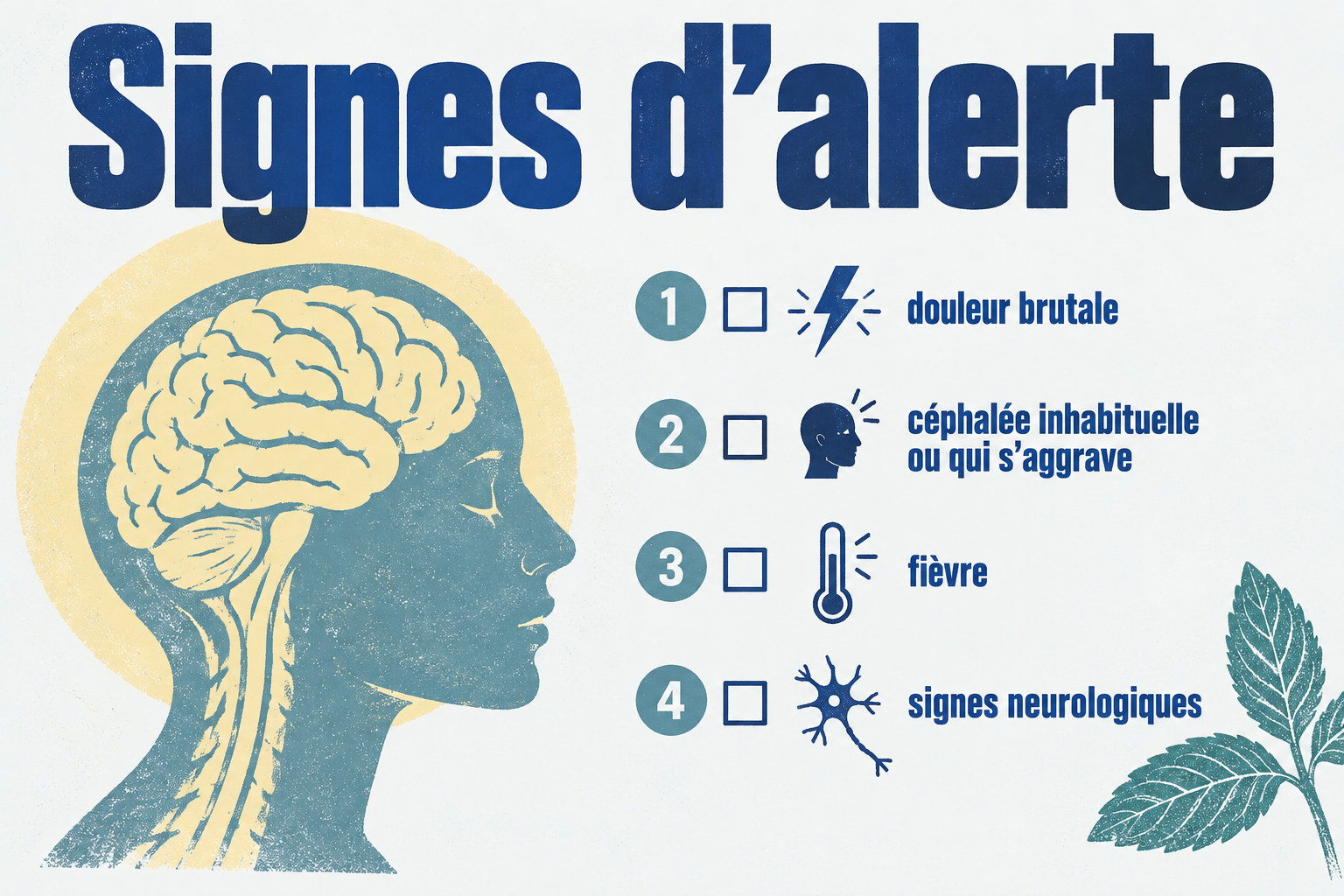
The guidance from France's health insurance service sets out these situations in detail. The rest of the time, your peppermint roll-on simply goes with your moments of rest.
Frequently asked questions
Where do you put peppermint oil for a migraine?
Apply diluted peppermint essential oil to the back of the neck, then lightly to the temples, in small circles. Keep away from the eyes and wash your hands after applying it.
Which essential oil should you use for migraines?
Peppermint is the essential oil most traditionally used during a migraine, for the coolness of its menthol. True lavender complements this ritual well in a diffuser, for a softer atmosphere.
Does peppermint essential oil have anti-inflammatory properties?
That is not how it is used: people value it for the cooling sensation of menthol, in a diluted massage on the neck and temples.
Can you use peppermint oil for a migraine during pregnancy?
No, peppermint essential oil is not advised during pregnancy or breastfeeding. Talk to your doctor or midwife about your migraines, and they will guide you towards a suitable option.